Risk vs Reward: Strategic Analysis of Free Kick Takes
Se quiser ler este texto em pt-br, clique aqui.
Direct shot or cross?
FREE KICK! Your team’s number 10 is brought down near the box, and you wonder: should we take a direct shot? Cross it into the area? This is exactly what ACE Lab set out to analyze.
Using open data from StatsBomb, we decided to conduct an analysis of free kick takes to discover the true cost-benefit of each strategy, evaluating the risk (chance of suffering a dangerous counter-attack) and reward (chance of scoring a goal) associated with both direct free kicks and crosses.
Methodology: How to calculate risk vs reward?
But how can we actually calculate the risk vs reward of a free kick take?
For direct free kicks:
As a reward, we use the xG and result generated from the shot (goal or not). As a risk, we check if there is a counter-attack in the subsequent possession and, if so, we evaluate the xG and result of that shot.
For crosses:
As a reward, we measure by the first shot by the team in the same possession, within 30 seconds after the take. If a shot is found within this window and in the same possession, its xG and result (goal or not) are attributed as the reward of the play. If no shot occurs, the reward is considered zero.
For calculating the risk in crosses, we look at the immediately following possession. If it belongs to the opponent and configures a counter-attack, we calculate the xG generated by this counter play and the final result (goal conceded or not).
Results Visualization
To visualize these results, we generated several types of heat maps. Let’s go through them:
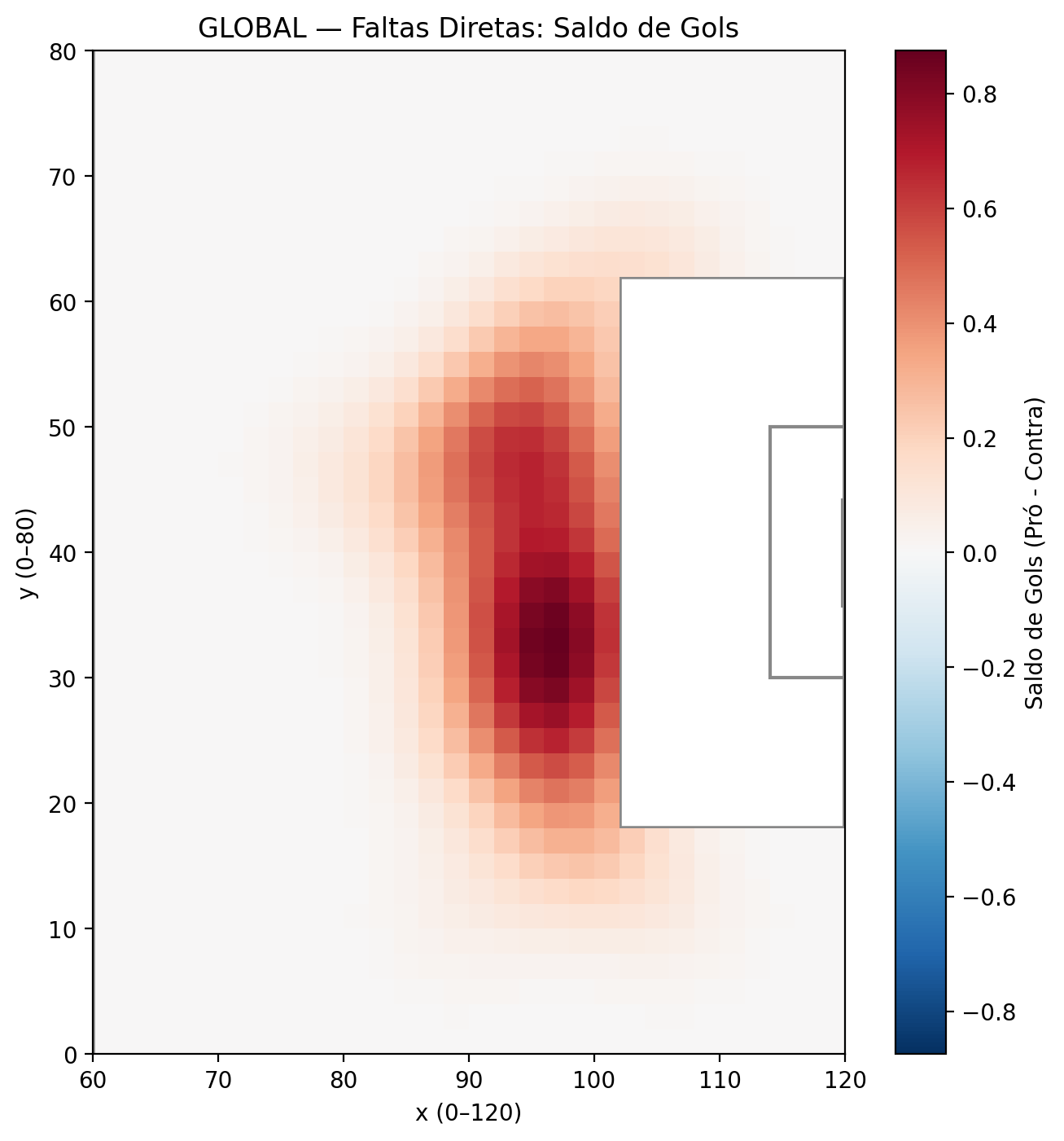
Net Goals and Risk-Reward Heatmaps (direct free kicks)
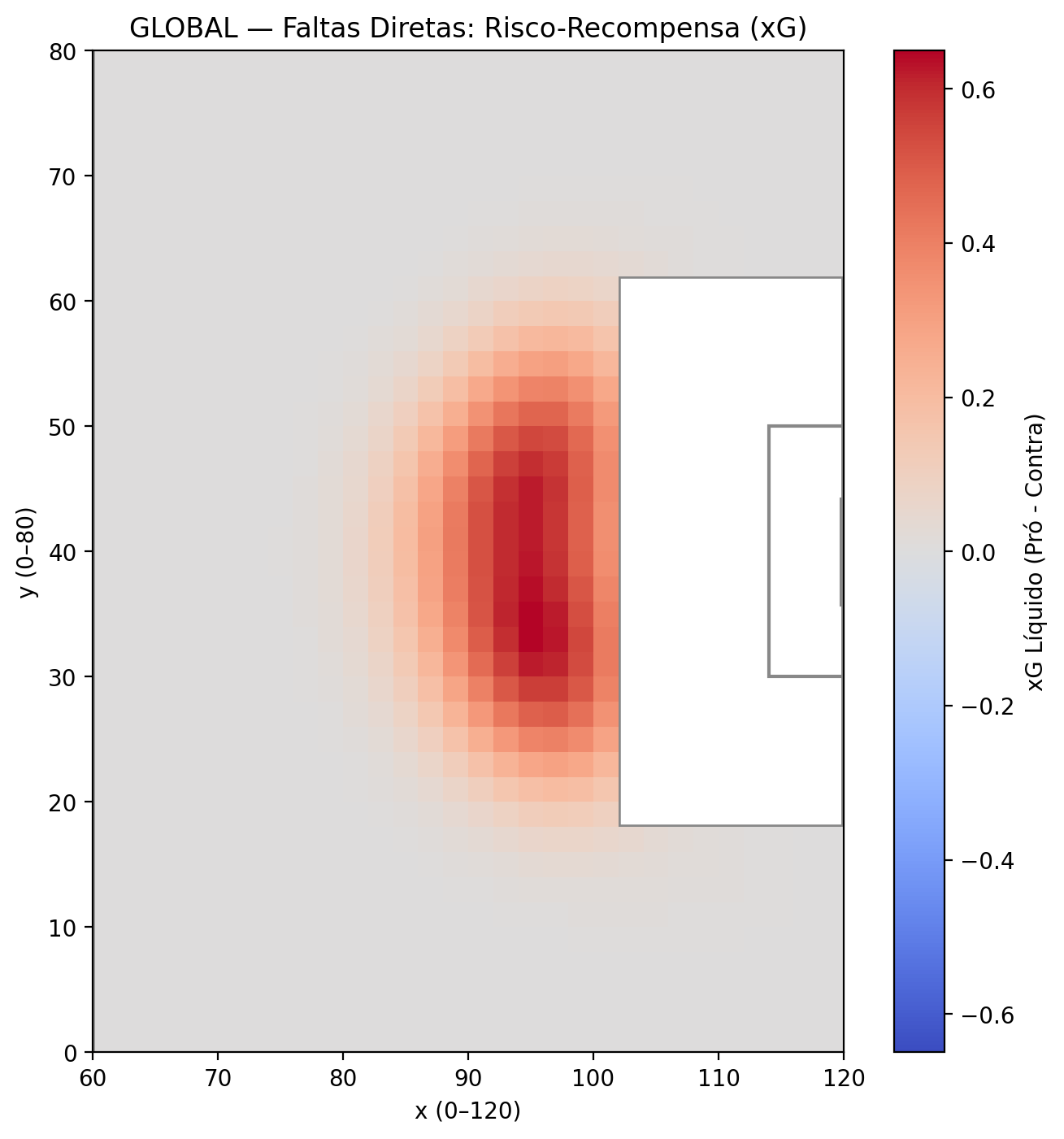
These show which areas of the field offer greater or lesser danger in the direct shot strategy, compared to zones where the take more frequently results in counter-attacks. It is observed that the patterns found are quite close to what is intuitively expected: the most dangerous free kicks are generally concentrated in regions immediately close to the edge of the box, especially when positioned centrally in relation to the horizontal axis of the field.
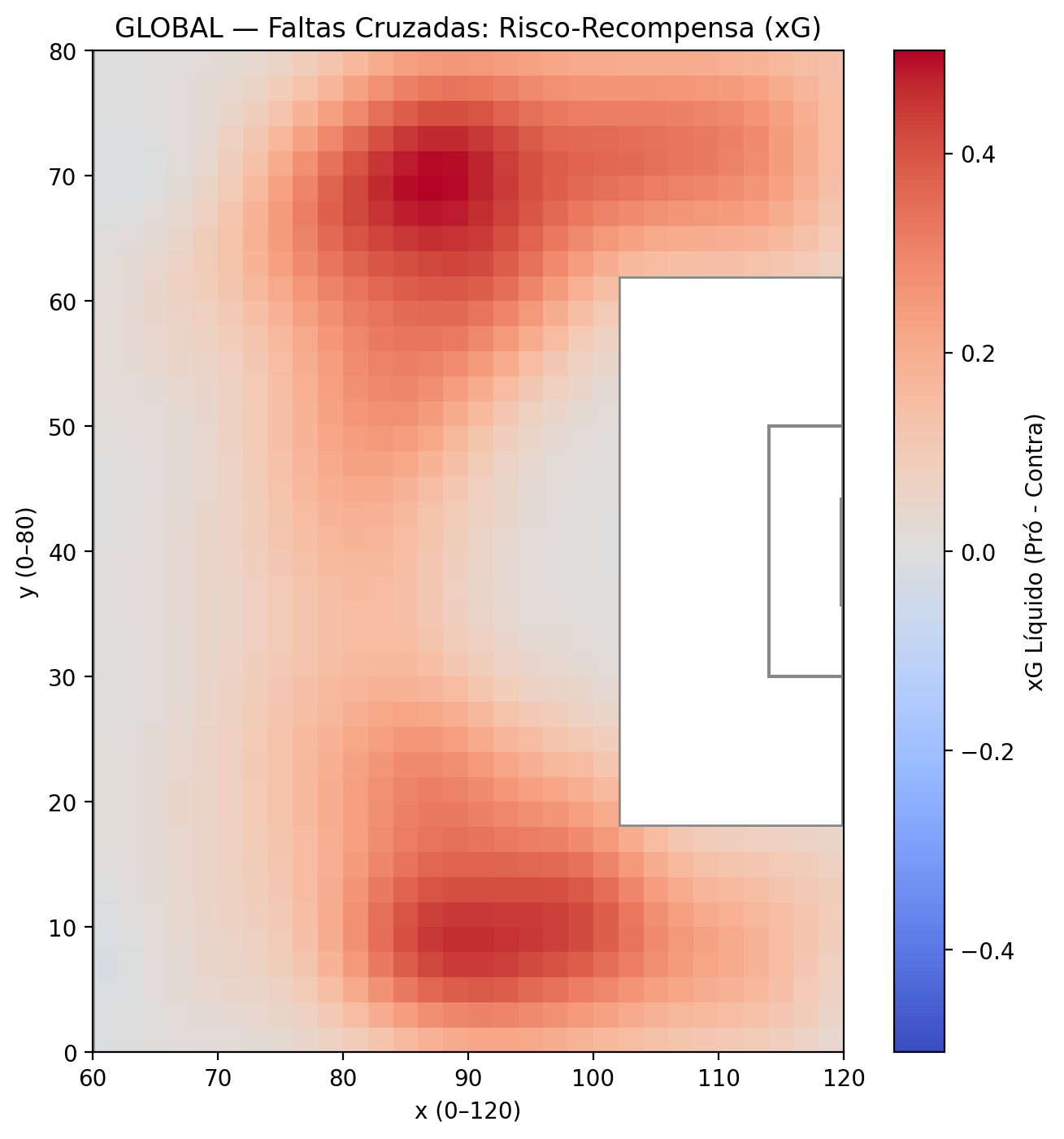
Net Goals and Risk-Reward Heatmaps (crosses)
These show the danger levels of crossed free kicks, compared to zones where the attempt more frequently results in counter-attacks. Here, it is observed that the results also follow intuition. Crosses made, especially in the lateral lanes adjacent to the box, concentrate greater offensive potential, while actions originating from more withdrawn zones tend to present lower return and greater defensive risk.
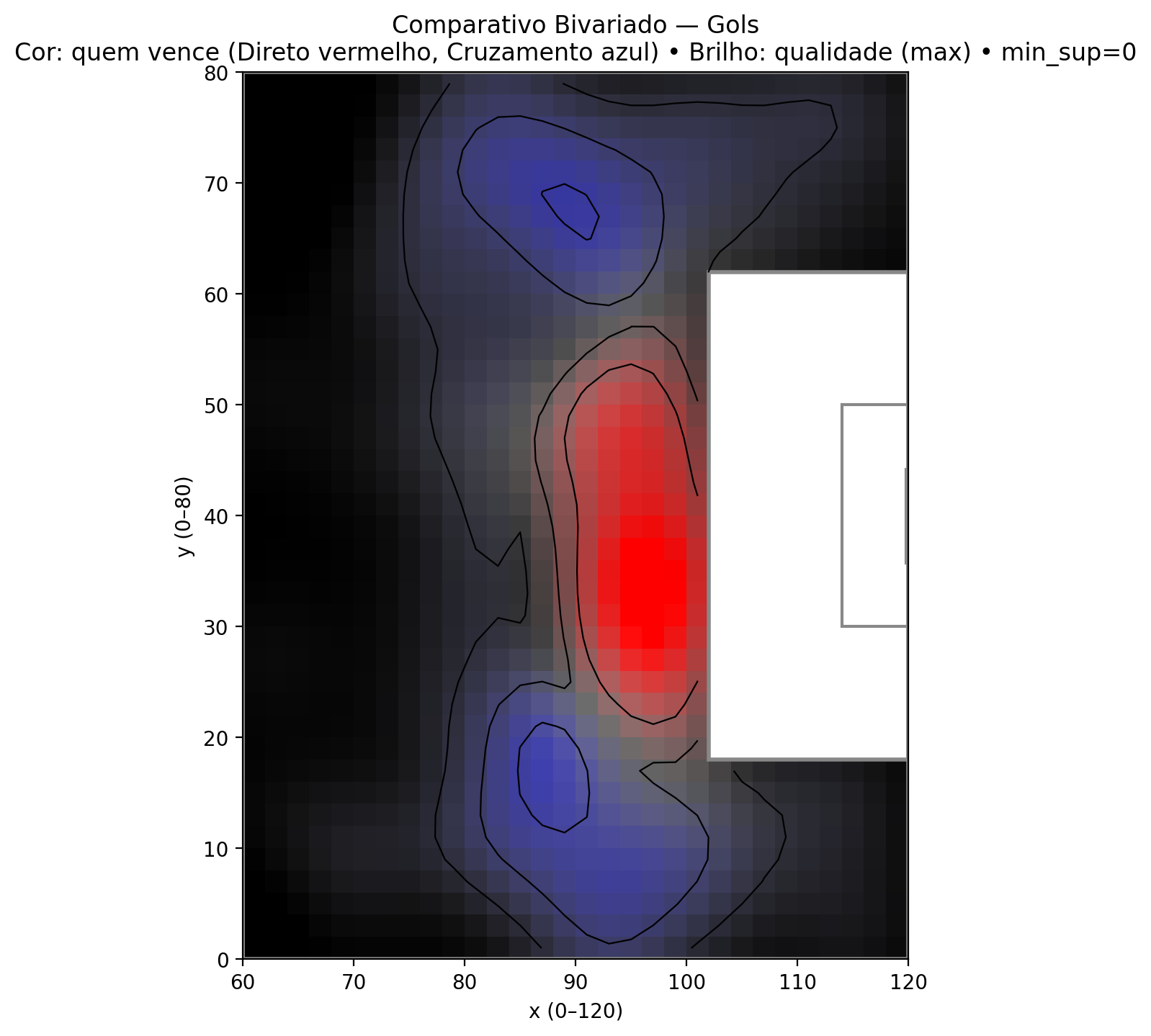
Comparative Strategy Heatmaps
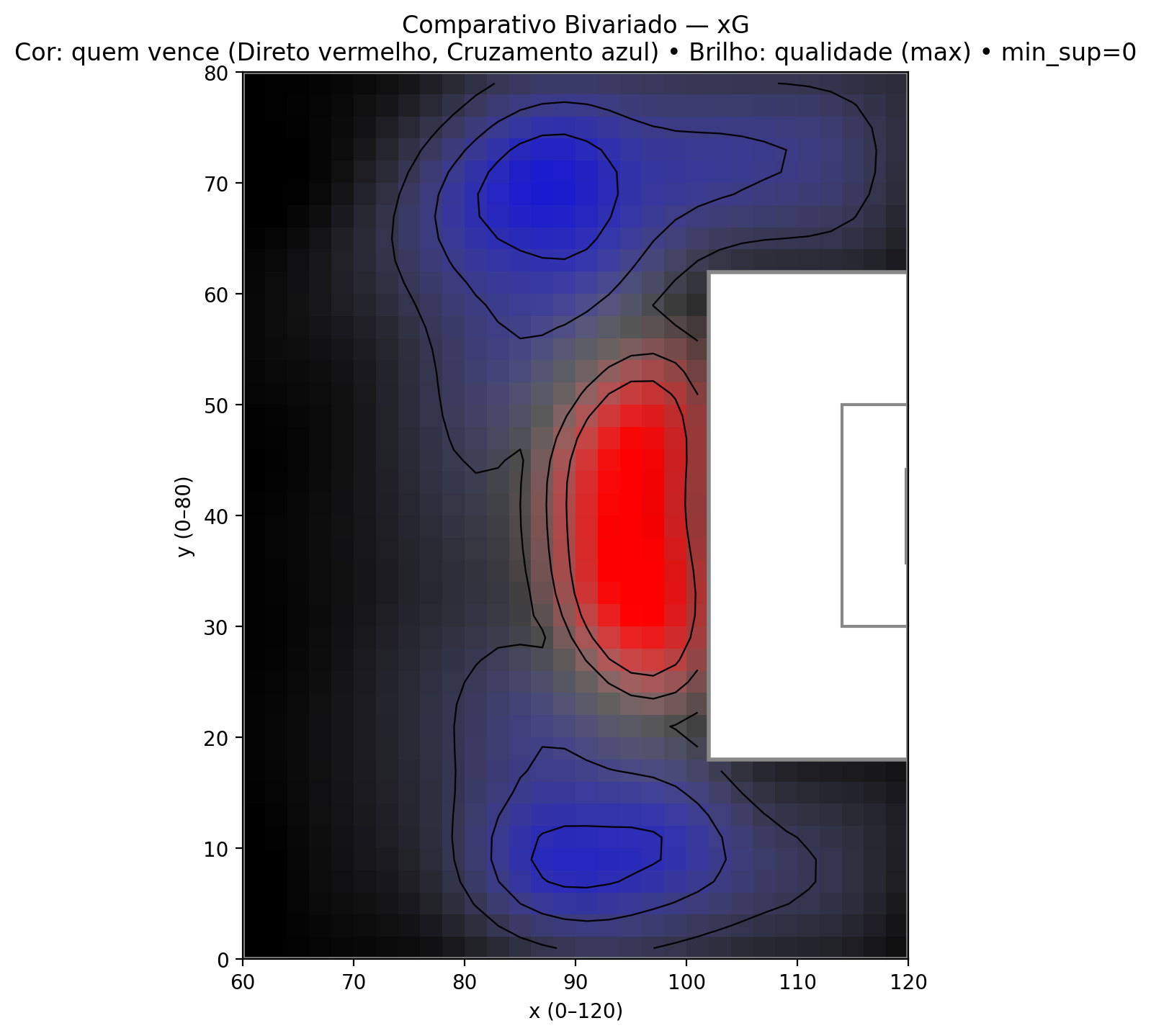
These identify, at each field position, which type of take tends to be more advantageous. Color coding indicates the dominant strategy in each region, with direct shots in red and crosses in blue, while pixel brightness is proportional to the opportunity quality, measured by the highest xG/goals observed at that location. Thus, brighter regions represent zones of greater offensive relevance, while darker areas indicate positions where both strategies show similar performance or low return. The maps show that direct shots predominate in central zones near the box, while crosses stand out in the lateral lanes of the final third of the field, reflecting patterns consistent with previous visualizations.
Comparative Efficiency Heatmap
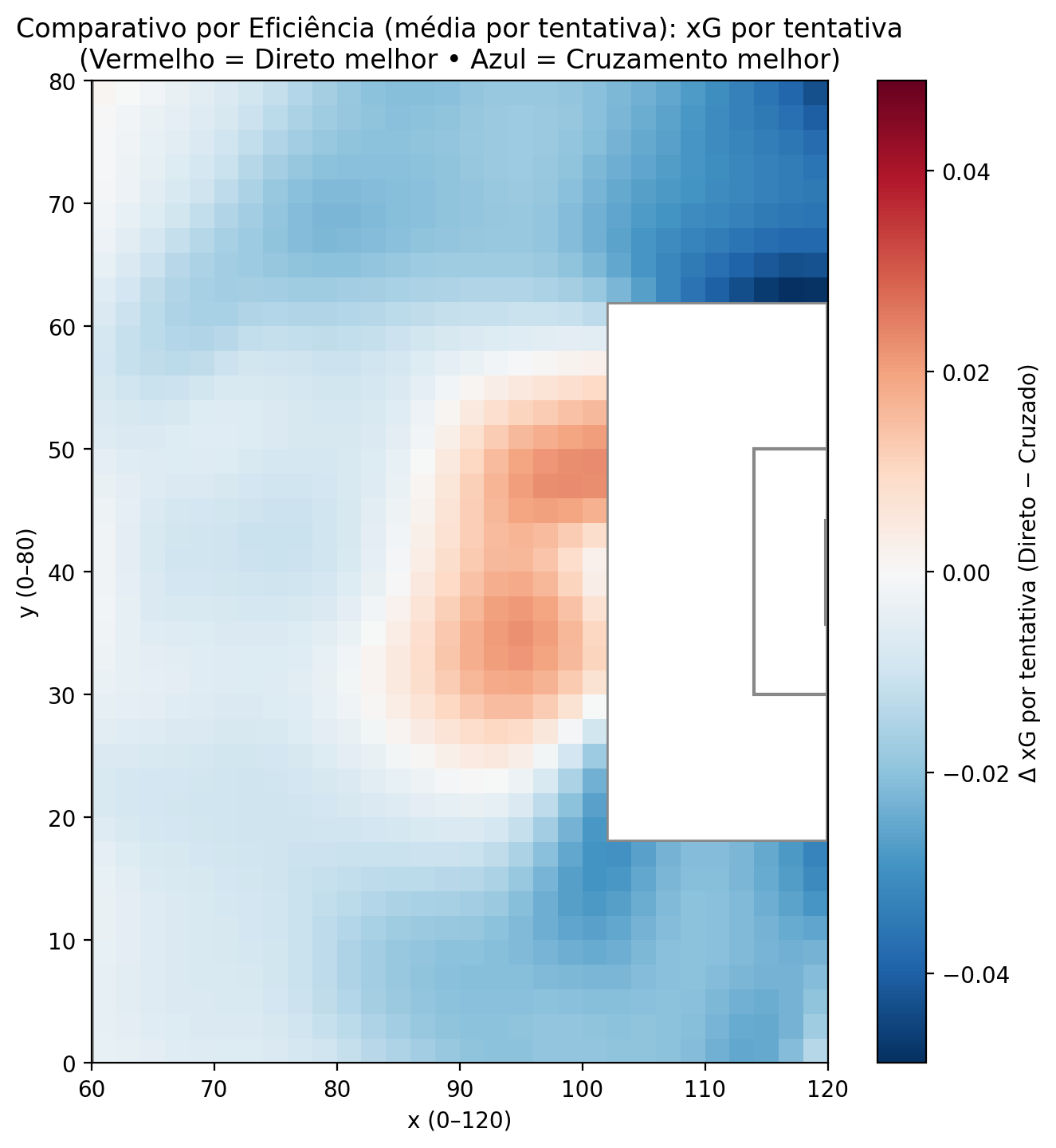
Complementing the bivariate comparative maps, the efficiency per attempt heatmap refines the analysis by considering the average quality of actions performed in each field region. The observed patterns reinforce previous results: direct shots show greater efficiency in central zones near the box, while crosses present relative advantage in lateral lanes and regions farther from goal.
Conclusions
The analysis of free kick takes, using StatsBomb data, allowed us to quantify the risk-reward associated with direct free kick and cross strategies, confirming common intuition.
Direct Free Kicks: The risk-reward is more favorable in central zones adjacent to the penalty area. This pattern suggests that direct shots are the dominant and most efficient strategy in these regions.
Crosses: Crosses present better reward and lower risk in the lateral lanes of the final third of the field. Crosses originating from more withdrawn areas tend to present lower offensive return and greater defensive risk.
Therefore, based on this study, we can confirm that evidence points to direct shots as the best option in central regions near the box, while crosses are more effective in the lateral lanes of the offensive field.
Enjoy Reading This Article?
Here are some more articles you might like to read next: