Analysis: France vs Morocco and Spain vs Belgium - World Cup 2026
Se quiser ler este texto em pt-br, clique aqui.
Analysis: France 2-0 Morocco
The knockout clash put African resilience to the test, missing their main standout and top scorer Ismael Saibari, against European favoritism, ending in a 2-0 victory for France. The outcome of the match confirmed the trend of superiority and the French capacity to suffocate the opponent and create opportunities in tight spaces.
Both national teams started with a 4-2-3-1 formation, but their tactical dynamics soon diverged. France adopted a fluid and aggressive posture in possession, frequently attacking in high blocks with many players in the attacking half, which granted complete freedom for Doué, Mbappé, and Olise to dominate between the lines. On the other side, Morocco attempted to congest the midfield in a defensive 4-4-2 that, under pressure, quickly sank into a deep 5-4-1 defensive block.
First Half: French Suffocation and the Moroccan Defensive Lock
The initial stage was a monologue dictated by European intensity. France opted to push its lines higher in an extremely aggressive manner, intensely pressing the opponent in their own defensive half.
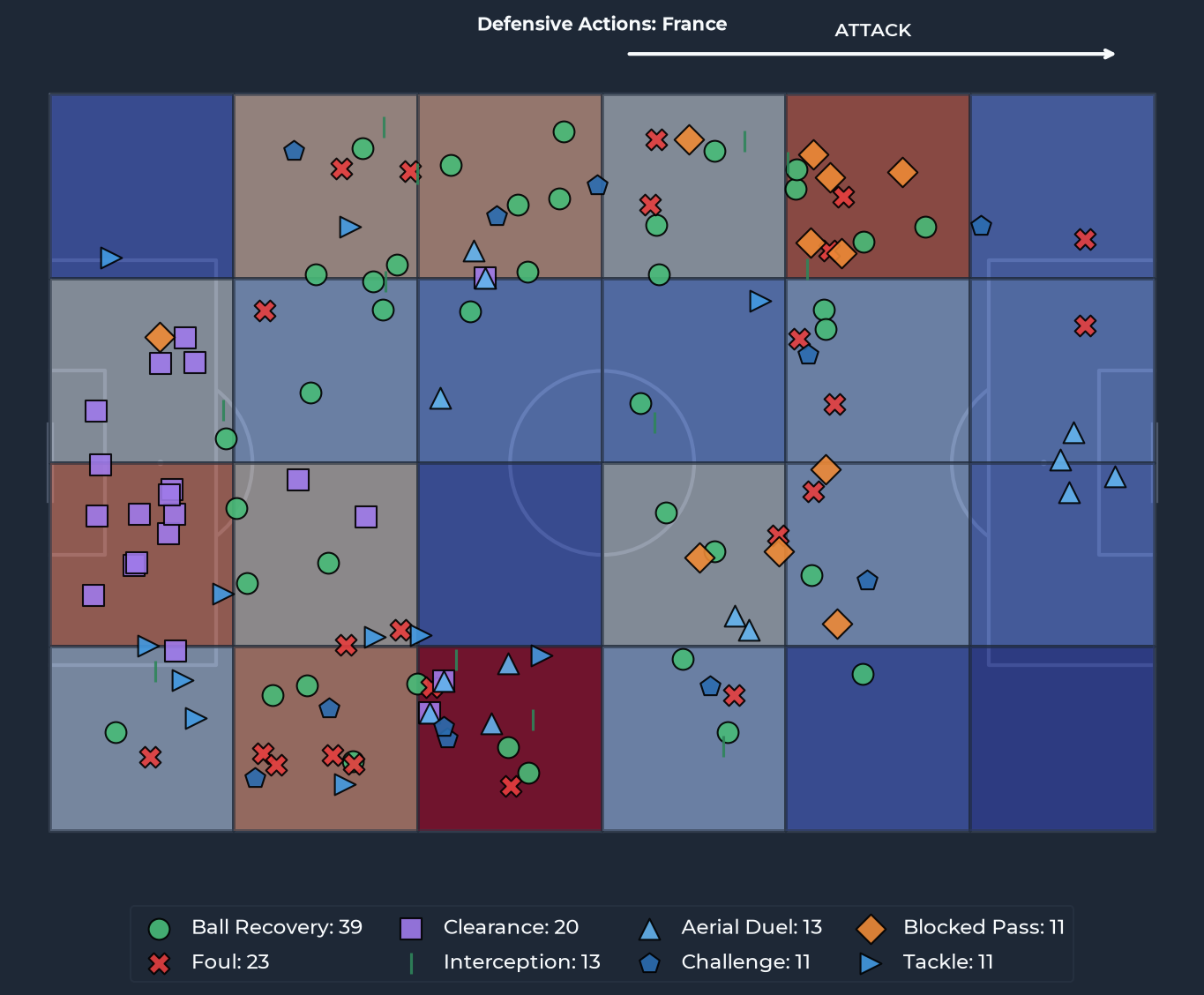
As illustrated in Figure 1, the heavy concentration of ball recoveries and blocked passes in the attacking half proves the strategy of suffocating any Moroccan transition attempt with vigorous marking immediately after losing possession. Forced to operate against this high press, Morocco had no alternative but to drop all its players back, trying to survive by closing off access to its own penalty area. The team abandoned attacking and became extremely compact.
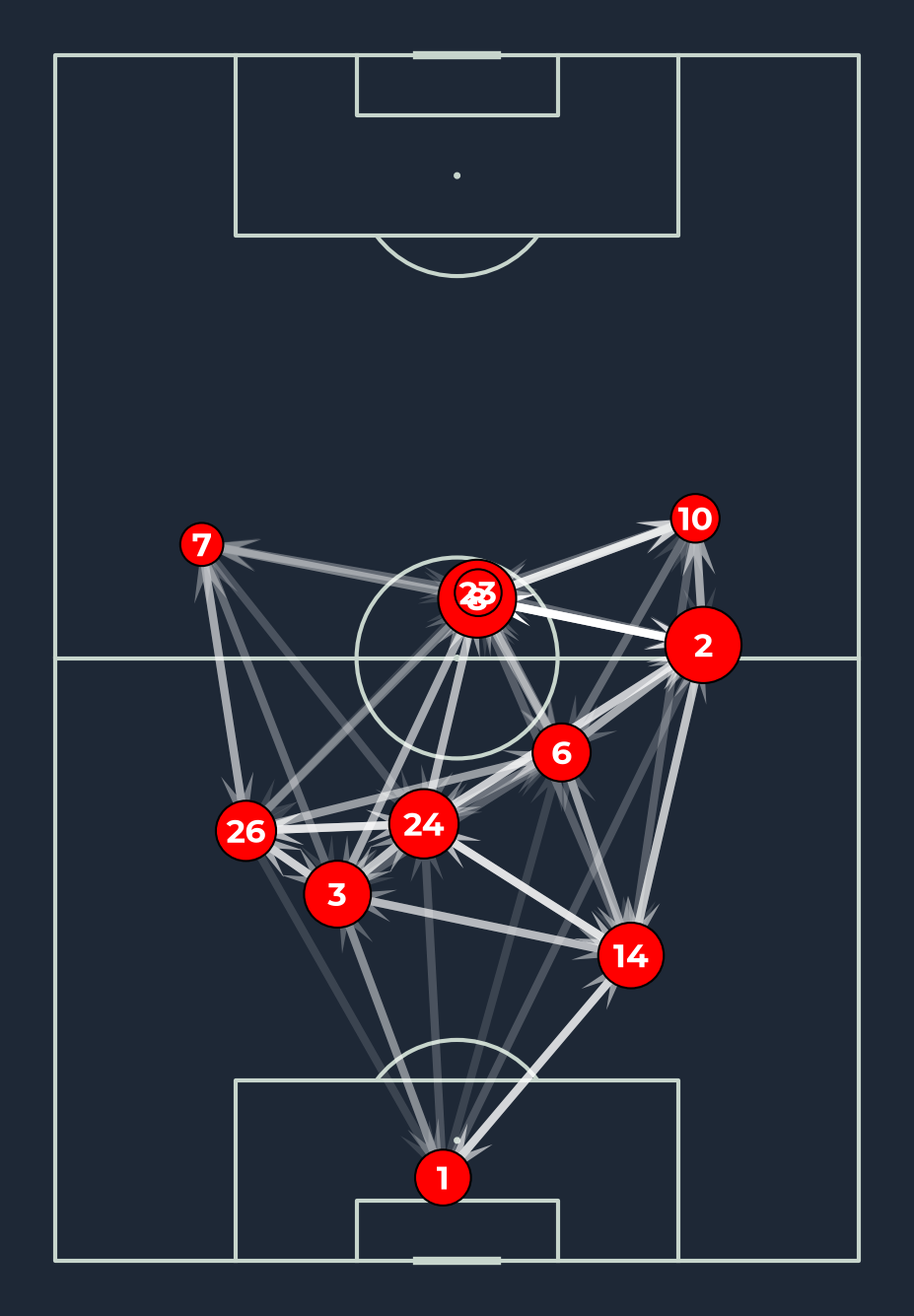
The visualization in Figure 2 highlights how compact the African team was forced to play, with their connections limited almost entirely to their own defensive third. The very deep and dense block prevented an immediate goal but invited constant danger. Despite the initial bombardment, which included great saves by Bounou, a shot against the crossbar by Digne, and a missed penalty by Mbappé, the five-man defensive wall managed to take the 0-0 draw to the locker room through sheer sacrifice.
Second Half: The Resolution in Tight Spaces
Returning from halftime, Morocco attempted to slightly advance its players in search of offensive breathing room. However, the French tactical adjustment raised the level of the game: the team maintained its aggressiveness but found lethality in quick combinations against an opponent that began to concede gaps while trying to build out from the back.
The climax occurred in a lethal six-minute window. At the 59th minute, France proved its repertoire for breaking through deep defenses in minimal spaces: Doué controlled the ball and found Mbappé to make it 1-0. The fatal blow came at the 65th minute. After a clever throw-in and a pass from Olise, Mbappé made a diagonal run off the ball that dragged the marking defenders away. This brilliant movement opened the exact space for Dembélé to advance freely through the middle and place his shot, settling the match.
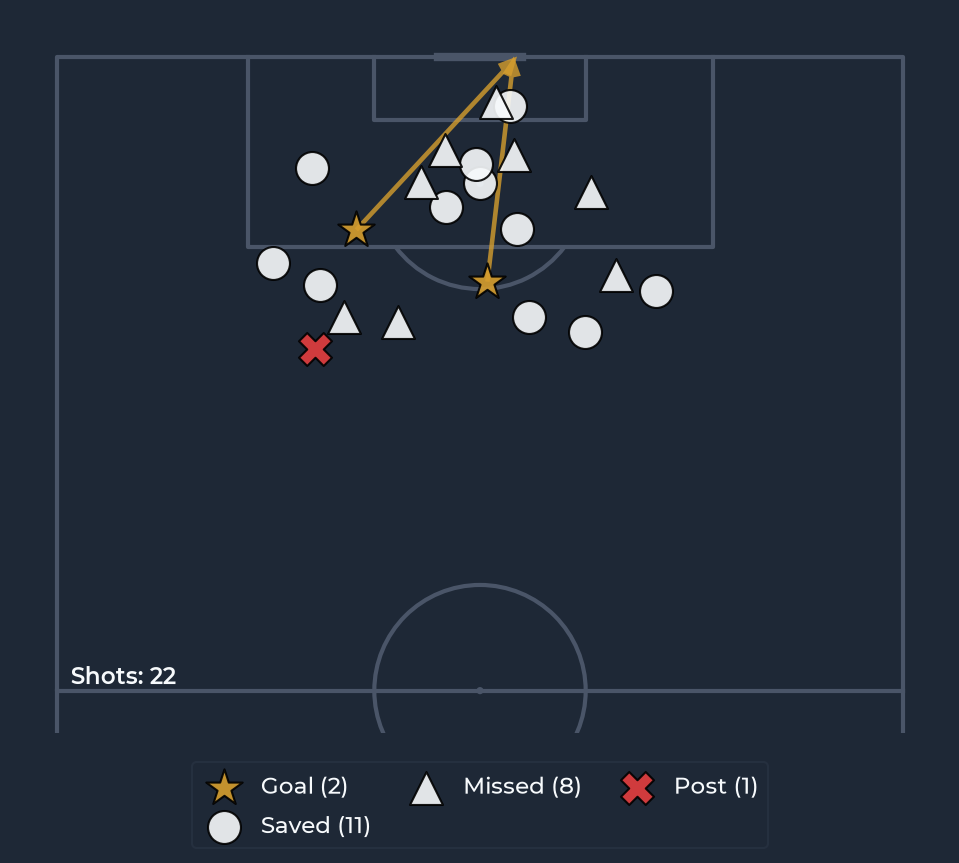
The numerical portrait of this absolute dominance can be observed in Figure 3, which translates the European offensive volume into 22 total shots, concentrating the greatest danger and the two goals in the vicinity of the penalty spot.
Conclusion
The French victory is justified by their excellent performance and was no coincidence, exposing the disparity in offensive production between the teams over the 90 minutes.
The European squad delivered a “perfect game.” The team nullified the opponent at the origin of their plays and dismantled the robust defensive system using creativity in tight spaces. For Morocco, the elimination concludes their journey and reveals the team’s offensive limits when missing key attacking players against a global powerhouse.
France advances to the semifinal consolidated as the tournament’s main force. The only necessary adjustment involves the medical department: Mbappé was replaced by Mateta after taking a knock to his foot. However, the smiles on the bench at the end of the game indicate it was merely a precaution for the next, and decisive, step in the competition.
Spain vs Belgium
Introduction
Spain defeated Belgium 2–1 and secured a spot in the World Cup semifinals. The Spanish team controlled the majority of possession and attacking play but struggled to convert that dominance into goals; despite creating numerous opportunities, they squandered key chances throughout the match. Belgium, meanwhile, adopted a more reactive approach, defending in a low block and looking to exploit the space left by Spain through rapid counter-attacks.
Spain prioritized possession, playing a 4-2-3-1 formation with Rodri and Fabián Ruiz providing balance in midfield, while Lamine Yamal and Álex Baena operated out wide. Belgium also lined up in a 4-2-3-1; Onana and Raskin shielded the defense from midfield, allowing De Bruyne greater freedom to orchestrate the play. Doku and Trossard played on the flanks, utilizing their speed during transitions to supply De Ketelaere, who led the attack.
First half
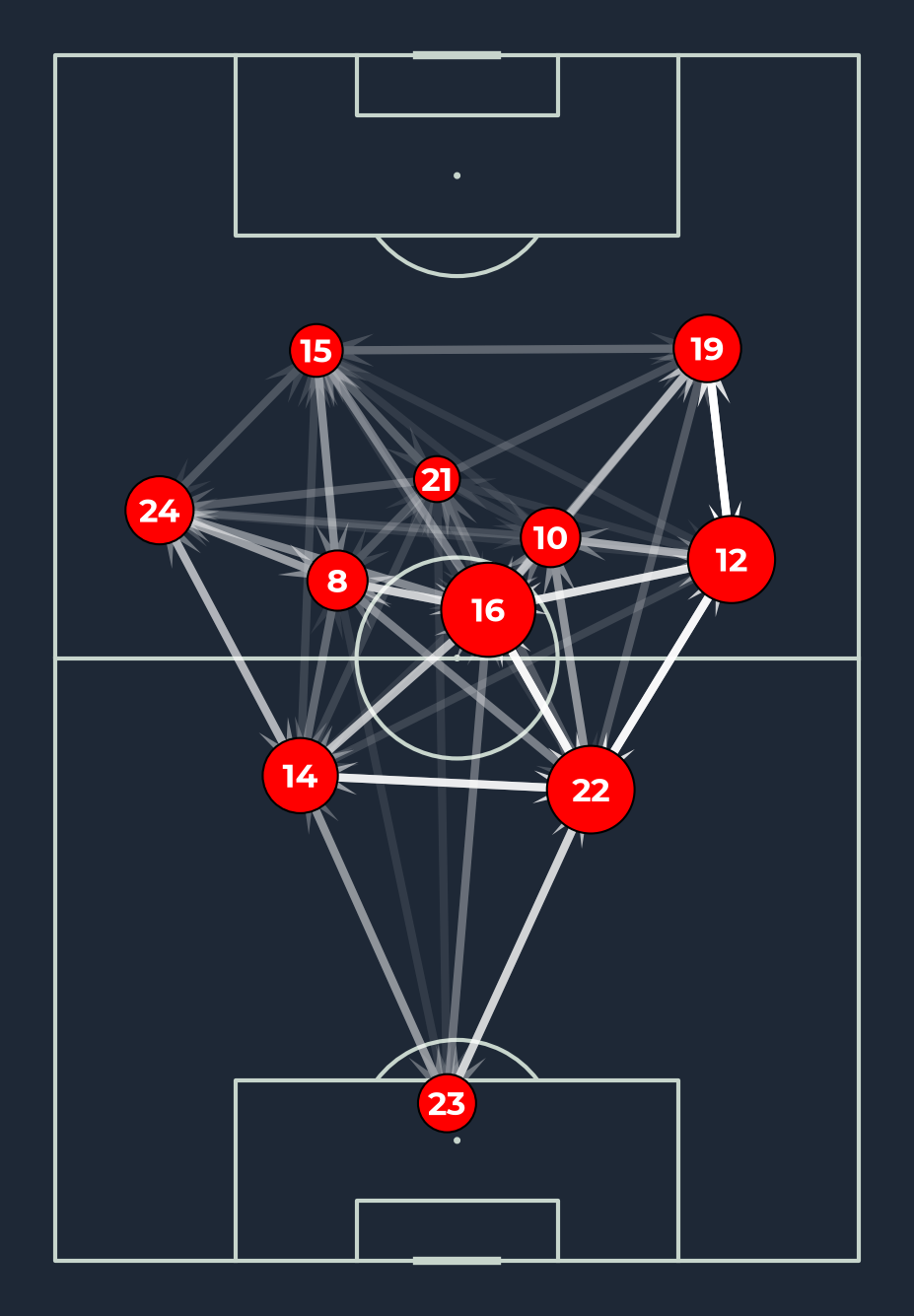
Spain controlled the game from the beginning, maintaining greater possession and building attacks mainly down the right side. Figure 4 highlights the key role of Rodri and Fabián Ruiz in ball circulation, while Pedro Porro and Lamine Yamal provided width.
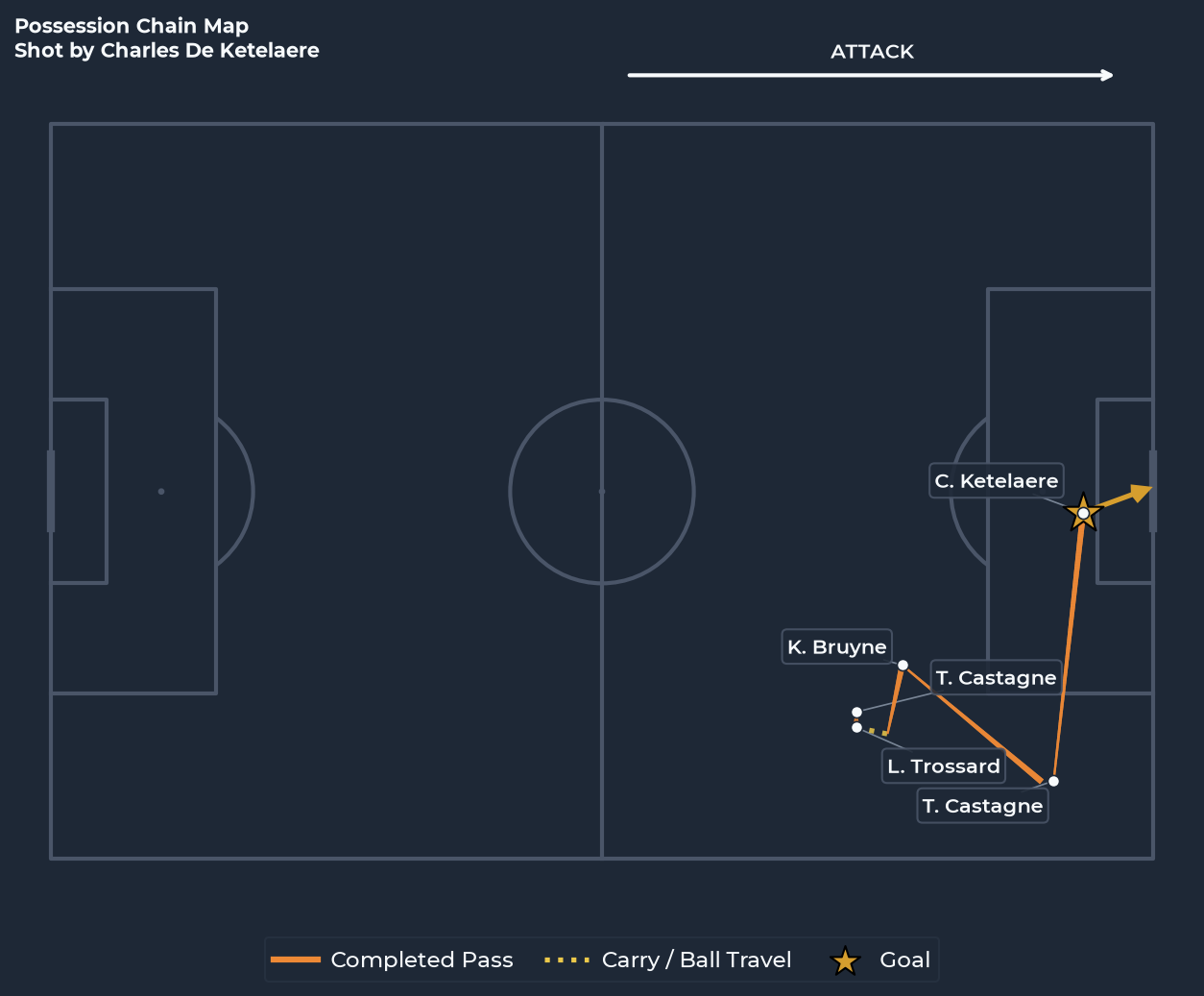
Despite dominating territory, Spain wasted good chances and struggled to break Belgium’s last defensive line. Belgium remained well organized defensively and accelerated transitions, taking advantage of spaces left during Spain’s defensive recovery. One such move resulted in the equalizer, exposing moments of defensive disorganization.
Second half
Spain maintained possession and increased attacking pressure, while Belgium defended deeper, as shown by the map of recoveries, clearances and tackles. Spain’s persistence paid off in the 53rd minute when Lamine Yamal scored. Belgium equalized in the 75th minute through Loïs Openda after another fast transition. Late in the game, after Thibaut Courtois left injured, Senne Lammens spilled a shot, allowing Mikel Merino to score the winning goal. Spain advanced 2–1 but still showed poor finishing efficiency and defensive vulnerabilities.
Conclusion
Spain was superior for the majority of the match, controlling possession and imposing its tempo through consistent passing. However, the team struggled to turn that dominance into goals and once again showed vulnerabilities during defensive transitions.
Belgium adopted a reactive strategy, defending deep near its own box and relying on counter-attacks to create threats. Although they managed to exploit some spaces left by Spain, the Spanish attacking pressure ultimately prevailed, securing a 2–1 victory and a spot in the semi-final against France.
Enjoy Reading This Article?
Here are some more articles you might like to read next: