Analysis: Argentina vs Spain - 2026 World Cup Final
Se quiser ler este texto em pt-br, clique aqui.
Analysis: Argentina vs Spain — 2026 World Cup Final
Introduction
The World Cup final tested everyone’s nerves from start to finish, culminating in a dramatic and thoroughly deserved victory for the Spanish national team. The match featured Spain completely dominating the actions against an Argentina that took the pitch focused solely on defending and trying to drag the game to penalties. More than the trophy itself, the significance of this result served to cement the immense mental resilience of the European squad in the face of a scenario of extreme pressure and constant tactical frustration. It was the triumph of a team that secured its survival not through a reliance on a single, genially isolated player, but rather by means of an extremely strong and cohesive collective system.
On the tactical board, the initial lineups showcased a true clash of styles. The core of the teams showed Spain structured in their traditional 4-1-2-3, going head-to-head with an Argentina deployed in a cautious 4-4-2. However, the way these formations translated in practice revealed the vast abyss of the matchup. With the ball, Spain fully controlled the tempo under the leadership of Rodri in midfield, projecting themselves forward to suffocate the opponent. Without the ball and in defensive transition, Argentina’s deep low block adopted an extremely withdrawn posture, practically only managing to attack sporadically through long goal kicks from their goalkeeper. It was the consolidation of ball-control dominance against a posture essentially focused on destroying plays.
First Half: The Trap and Illusory Control
In the opening minutes, the narrative of the duel materialized clearly: one team seeking to impose itself against another that accepted giving up possession. As early as the 4th minute, Lamine Yamal made the first dangerous incursion, and by the hydration break, Spain already boasted 62% possession compared to Argentina’s 38%. However, this dynamic of high pressure versus submission turned into a tactical trap. Spanish ball possession became illusory in a dense and gridlocked game, where a large part of the time was contested strictly in the midfield zone. The attempt to dictate the tempo encountered a passive wall that made transitions slow.
The behavior without the ball of the defending team bordered on intentional tactical passivity. Argentina completely abandoned pressing the European buildup, massing their defensive momentum heavily in their own defensive third. There was no interest in contesting the midfield or hounding the Spanish central midfielders, but rather in compacting the defensive lines close to their own penalty box and clearing any imminent danger.
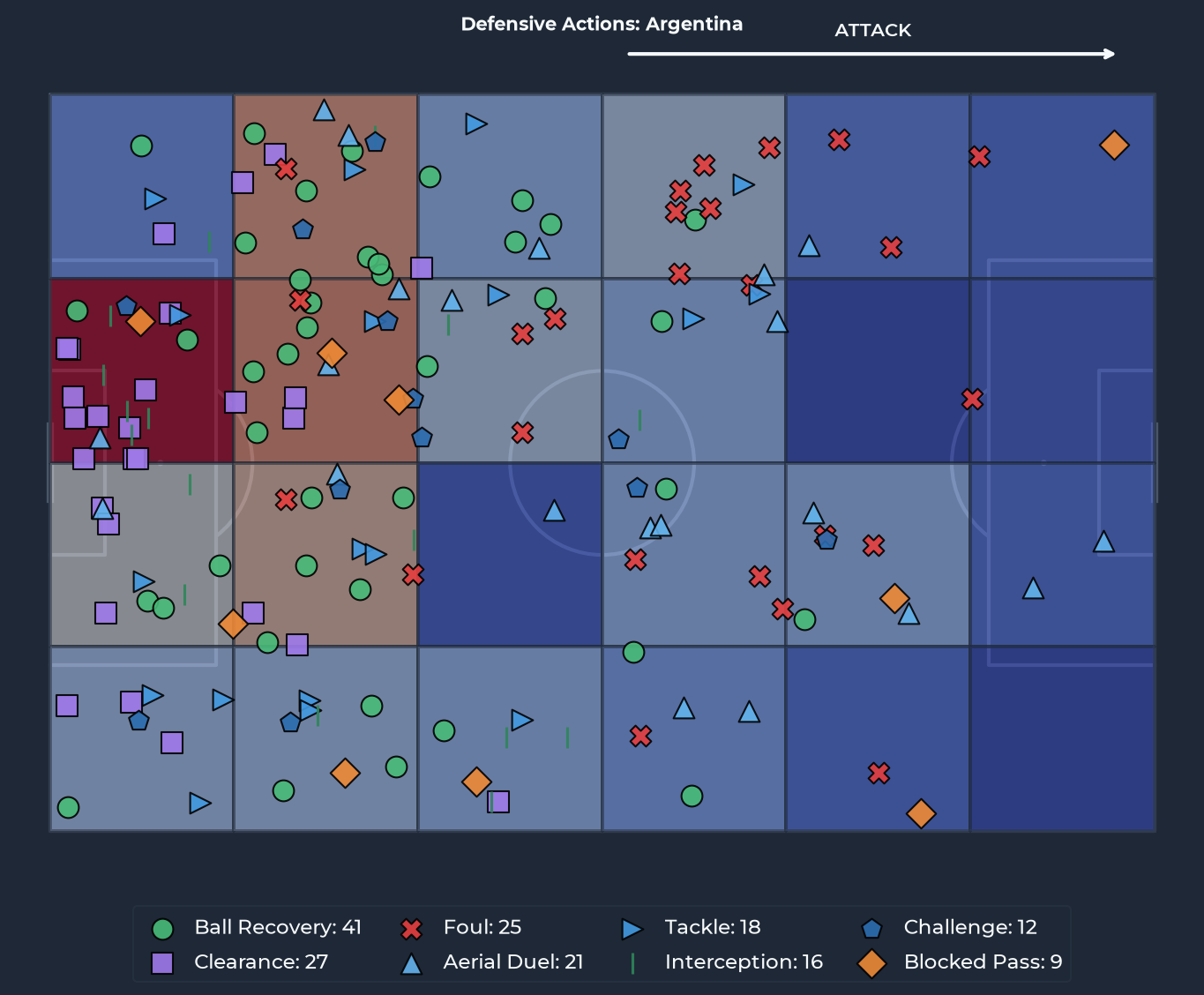
Despite dominating possession, Spain’s volume of play proved offensively sterile in the first 45 minutes. For the South Americans, the major blow of this stage occurred in the 43rd minute, when they lost center-back Lisandro Martínez to injury (replaced by Otamendi), which generated a psychological impact even before heading into the locker room.
However, if the Spanish attack kept hitting a brick wall, their defensive transition was flawless. In stark contrast to the South American passivity, Spain’s dynamic without the ball was active and highly efficient. The European team imposed aggressive marking from end to end. Unlike Argentina, which limited its combat almost exclusively to its own box, Spain’s tackles, tactical fouls, and ball recoveries occurred spread out across all areas of the pitch.
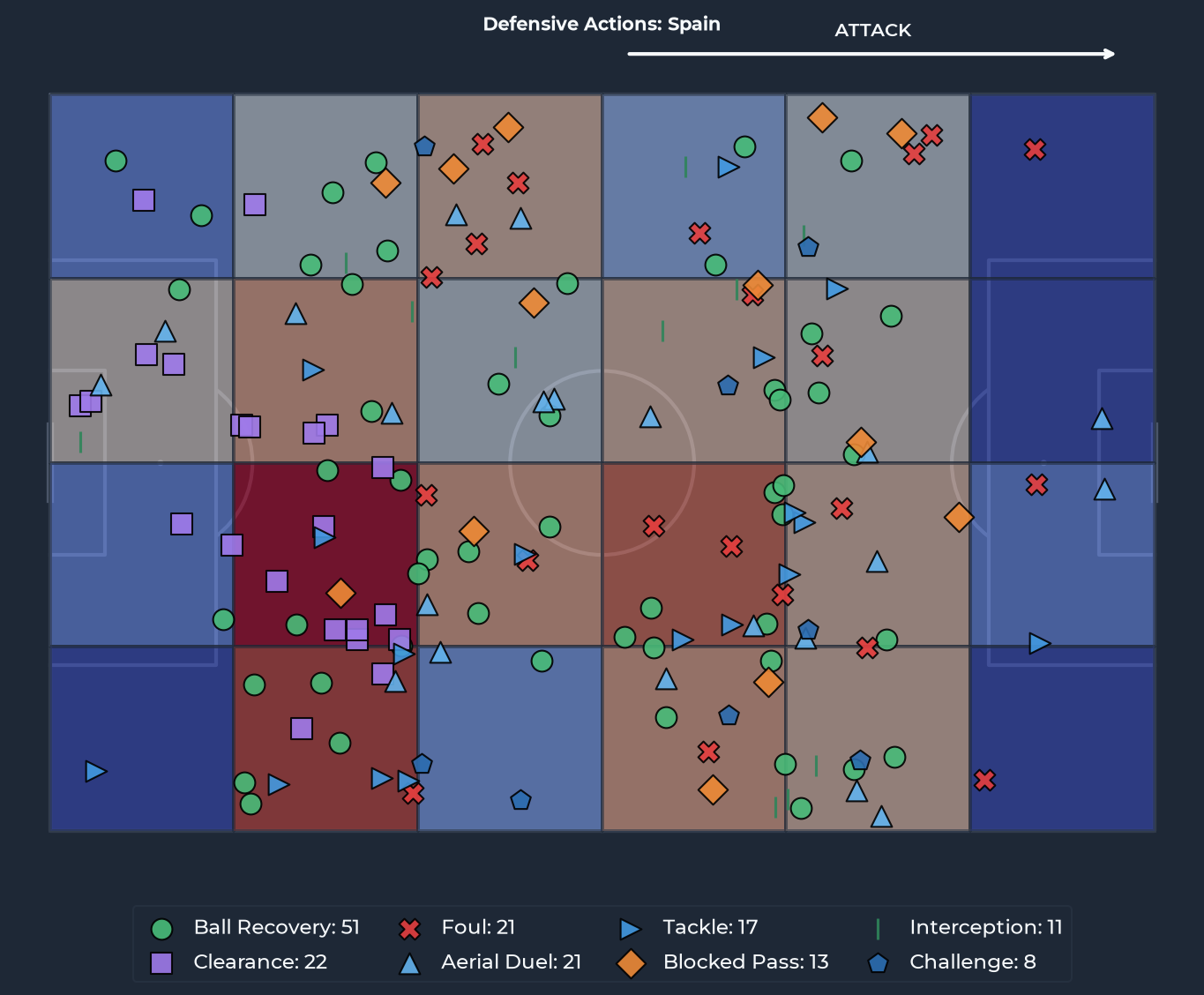
The structure of the side holding territorial dominance was confirmed by observing this advanced and global behavior. Spain maintained short and highly compact lines, suffocating the opponent’s buildup at its root and preventing any organized transition. This full-pitch defensive control resulted in an astonishing feat for a World Cup final: Argentina ended the first half without managing to unleash a single shot. The Spanish blockade was relentless, demonstrating that their most efficient defense was, in fact, constant high pressing.
Second Half: Adjustments, Pressure, and Redemption
Following an abnormally long 27-minute halftime show, the locker rooms provided adjustments and changes of course. Argentina tried to correct their inability to hold onto the game by subbing in Paredes for Nico González, aiming for better ball retention, but this attempt failed. Spain returned to the pitch even more incisive and aggressive, later introducing high-impact changes with the entries of Ferran Torres and Pedri in place of Oyarzabal and Fabián Ruiz, which refreshed the Spanish offensive machinery in the final third.
The impact of this adjustment was immediate: the game quickly became an attack-versus-defense monologue. Spain cornered the opponent in their own box, creating clear chances, such as Cubarsí’s great pass for Dani Olmo’s run right at the start of the second half. The discrepancy was notorious, with Spain racking up shots against an opponent that refused to take risks in the game.
The dynamic of Spanish pressure operated like a steamroller. The high concentration of offensive actions and ball recoveries resulted not only from continuous high pressing, but essentially from the risky and forced long balls launched by the Argentinian goalkeeper and his defense, who could not find safe passing lanes. Spain gathered these “gifts” in midfield and immediately went back to attacking the Argentinian defense.
Seeking new offensive resources to breach the barrier of defenders, the European national team began to involve their center-backs and full-backs in a deeper and more vertical manner. Cubarsí became a tool for line-breaking passes from the back, bypassing Argentina’s immense central block. Incursions down the flanks resulted in consecutive corner kicks.
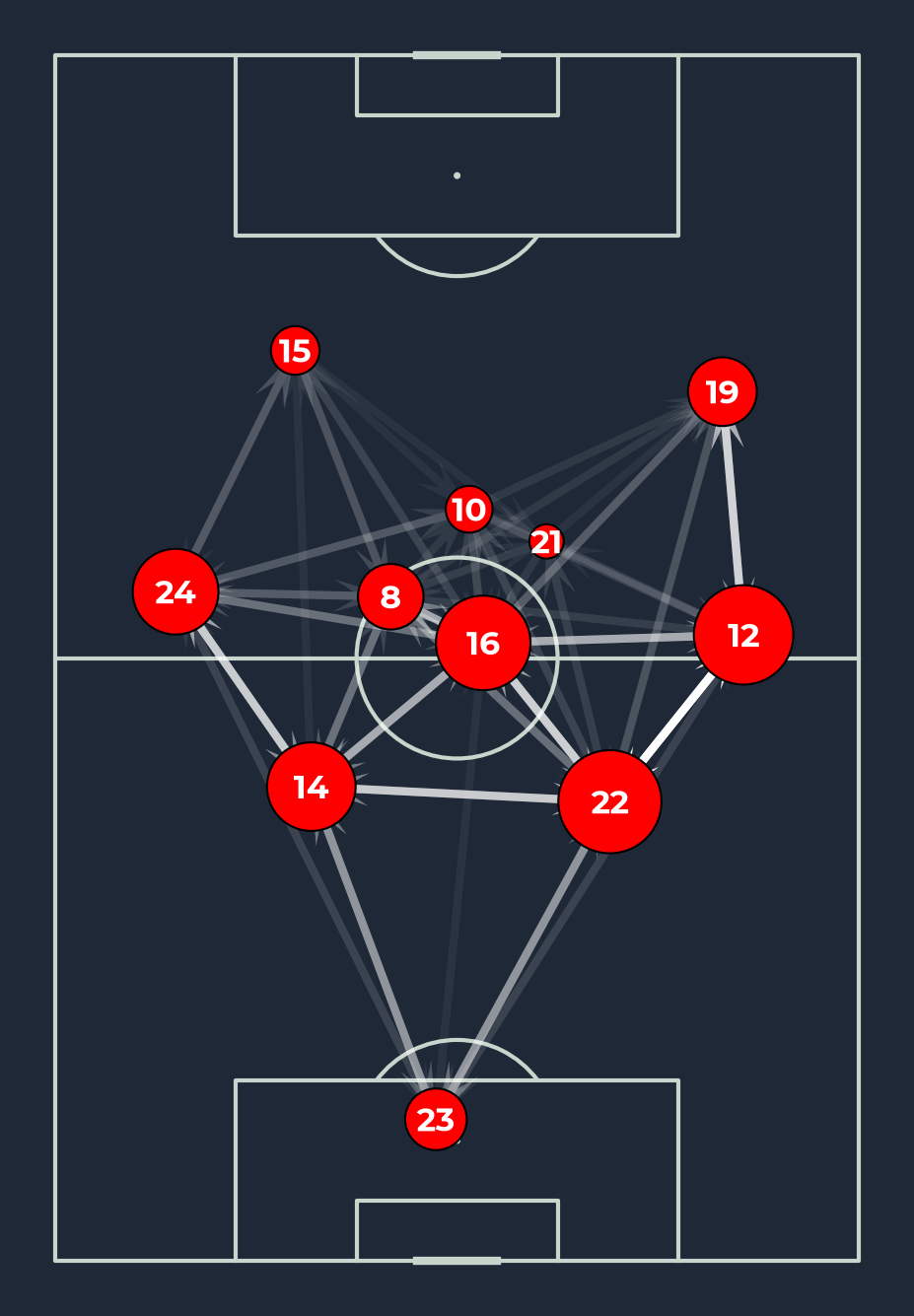
Yet, circulation problems still existed in the reading of the game. On the Argentinian side, the most severe problem of all took shape: the complete isolation of Lionel Messi. Nullified by Spain’s pressing mark, the number 10 became a hostage of his team’s struggles and touched the ball only 14 times in the second half (56 in the entire match). On the other side, even with possession, the Spaniards often circulated the ball peripherally, running into the opponent’s intense double-marking layers.
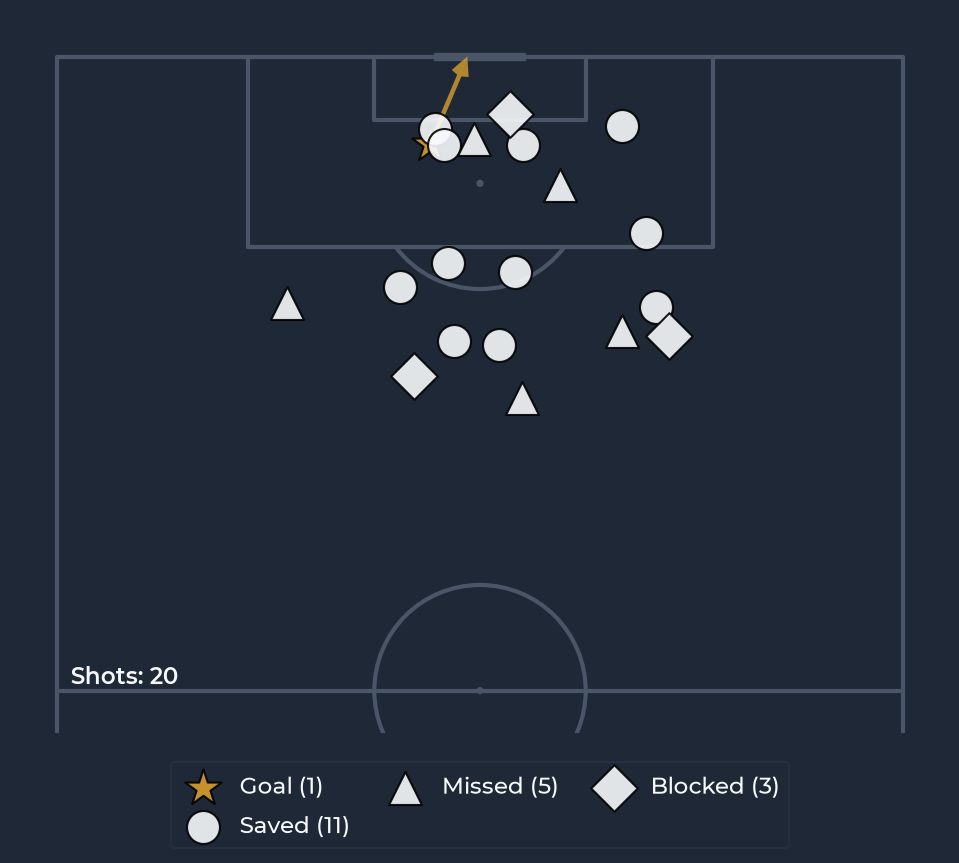
The suffocation nearly found redemption at the feet of the Europeans during regulation time, were it not for a miraculous performance under the opponent’s crossbar. Dibu Martínez, the Argentinian goalkeeper, was the main person responsible for maintaining the 0-0 scoreline, shining in such a way that he broke the historical record for saves by a goalkeeper in a World Cup final, frustrating Spain’s 16 attempts (11 on target) during the 90 minutes.
With the teams needing to manage their stamina in the face of exhaustion, the hydration breaks gained strategic weight. Lionel Scaloni burned his final substitutions at the 24th minute [of the second half], bringing on Simeone and Medina, leaving him with no changes available from the 70th minute of the match onward, while Spain tactically reorganized with the introductions of Nico Williams and Merino to keep their energy levels high.
Extra Time: The "Coup de Grâce" from La Roja
Even with the allowance of a new substitution and playing with one less player due to a red card, Argentina did not make immediate changes, and the Spanish pressure proved unsustainable. The crushing storyline reached its peak and frightening proportions: by the interval of extra time, the shot count already stood at a relentless 19 to 0 in favor of the Europeans.
The South American resistance finally crumbled just 35 seconds into the second half of extra time. Following an engaging offensive buildup, Nico Williams won the ball in the air and headed it down for Ferran Torres, who fired a shot past goalkeeper Dibu Martínez with no chance of a save, opening the score and materializing the superiority that had been drawn out over the entire matchup.
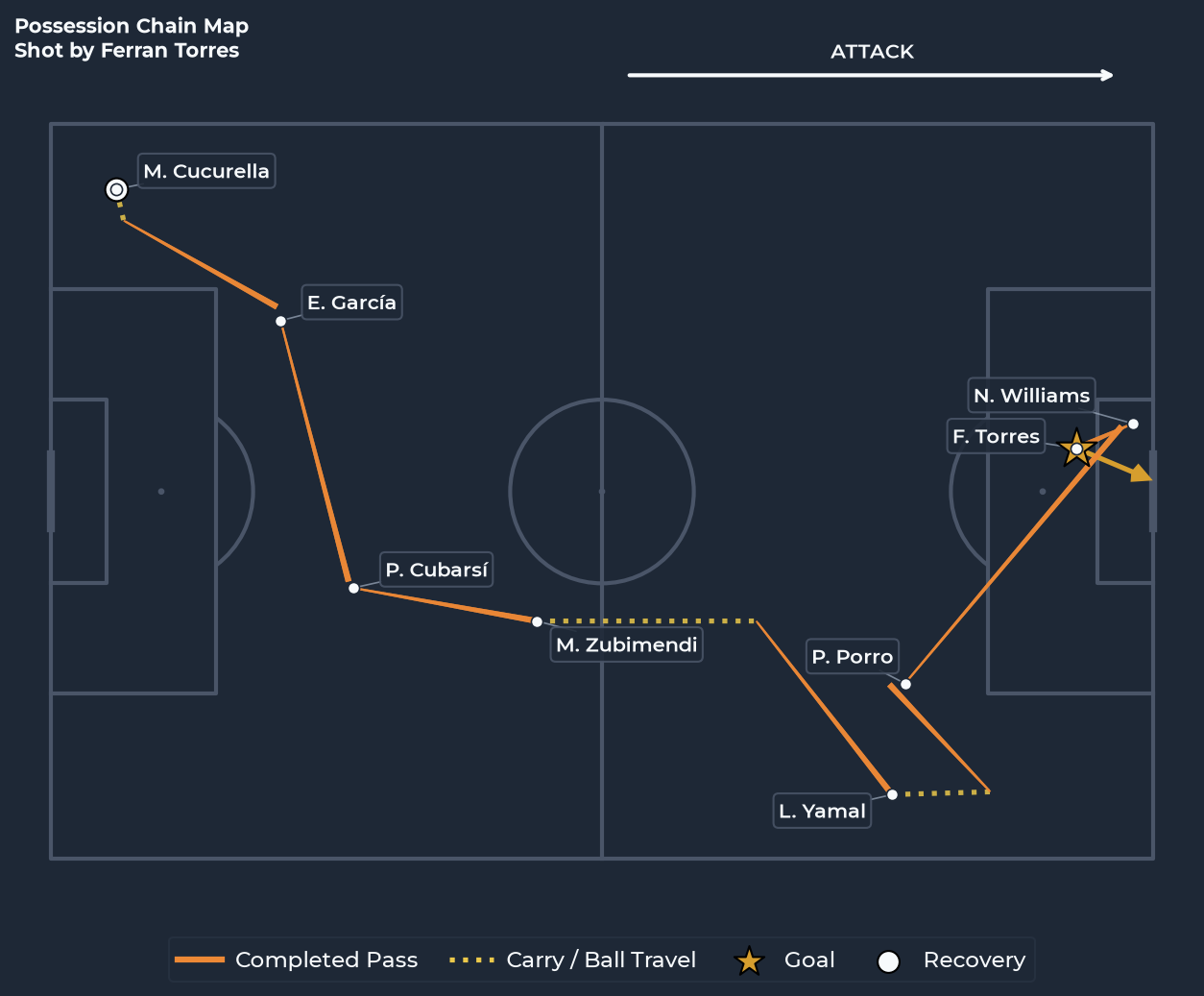
Behind on the scoreboard and dominated by desperation, Argentina only managed to record their first official shot in the 116th minute. Spain still missed a great opportunity to extend their lead shortly after through Nico Williams, but the last hope of South American survival fell to the feet of Gio Simeone, who blasted the ball over the crossbar from the penalty spot deep into stoppage time. Finishing with just two shots in more than 120 minutes of football, Argentina accepted their fate, sealing the European victory.
Conclusion: The Consecration of a Legacy
The final whistle crowned a rightful winner, faithful to their model forged in ball control over two decades. The Spanish defense deserves glorious honors, conceding only a single goal throughout the entire World Cup campaign, consolidating a machinery that achieved 13 victories on the journey to ultimate glory.
In the individual and medical assessment, Lisandro Martínez’s injury demonstrated how a casualty can emotionally rattle a defensive system, while Dibu Martínez emerges with reverence as the hero of an impossible resistance. For the champions, praise goes to Rodri, the tireless creative engine, and to the tactical acumen of the coach to modify the offensive weight at halftime and throughout regulation time.
Looking ahead to the outlook and lessons of the spectacle, the tournament proved that Argentina left their grit on the pitch but succumbed to their technical limitations against a lethal force that prevented them from playing. Spain now moves forward toward new winning cycles, knowing that future opponents will attempt to replicate equally tough defensive schemes, which will require constant evolution to keep the dream of retaining the title alive on the horizon of world football.
Enjoy Reading This Article?
Here are some more articles you might like to read next: