Analysis: England vs Norway and Argentina vs Switzerland - World Cup 2026
Se quiser ler este texto em pt-br, clique aqui.
Analysis: England vs. Norway
In a tense and highly patient encounter, England secured a spot in the World Cup semi-finals by overcoming Norway in extra time. The English national team showed resilience and tactical maturity to reverse an adverse scenario, eliminating a defensively well-organized opponent that was extremely lethal in transitions.
For the match, England adopted a 4-2-3-1 formation, seeking to dictate the pace through ball possession. The formation was based on a line of three attacking midfielders supplying the attack, with Jude Bellingham playing centrally and with the freedom to infiltrate. On the other side, Norway’s 4-3-3 required mutual adaptations: England needed maximum concentration at the back to neutralize Haaland, while Norway saw Ødegaard constantly drop back to organize the team from the base.
First Half: Sterile Possession and the Playmaker's Deep Drop
The game started slowly. England took the initiative and accumulated a lot of ball possession, but struggled to infiltrate and create real danger. This dynamic of “harmless control” repeated itself at several moments, with the English dominating territorially but failing to penetrate against a well-positioned defensive system.
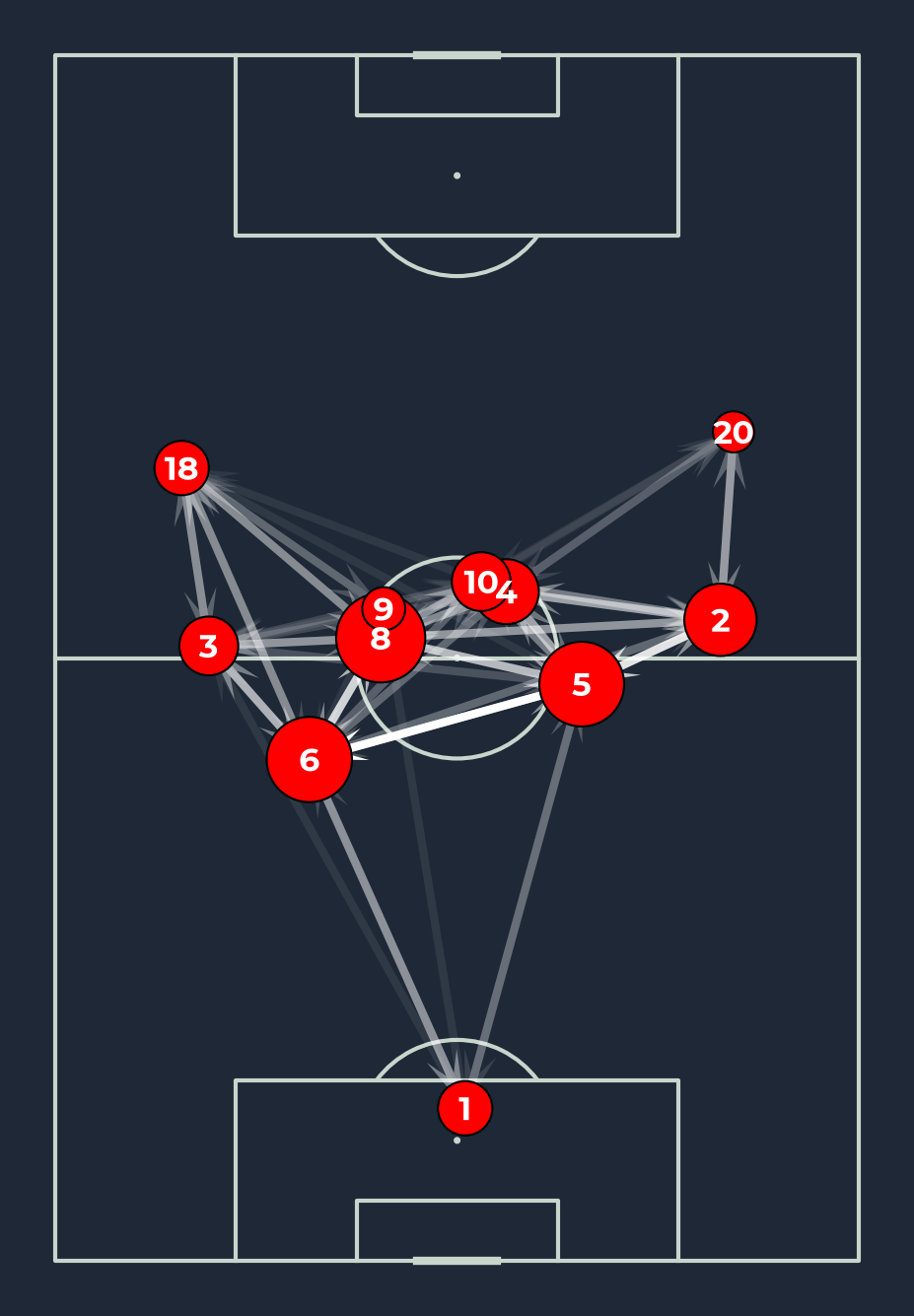
As illustrated in Figure 1, the high volume of passes highlights England’s difficulty in breaking lines. It is possible to visualize the possession in a “U” shape, indicating side-to-side cycles with problems infiltrating the finishing zones.
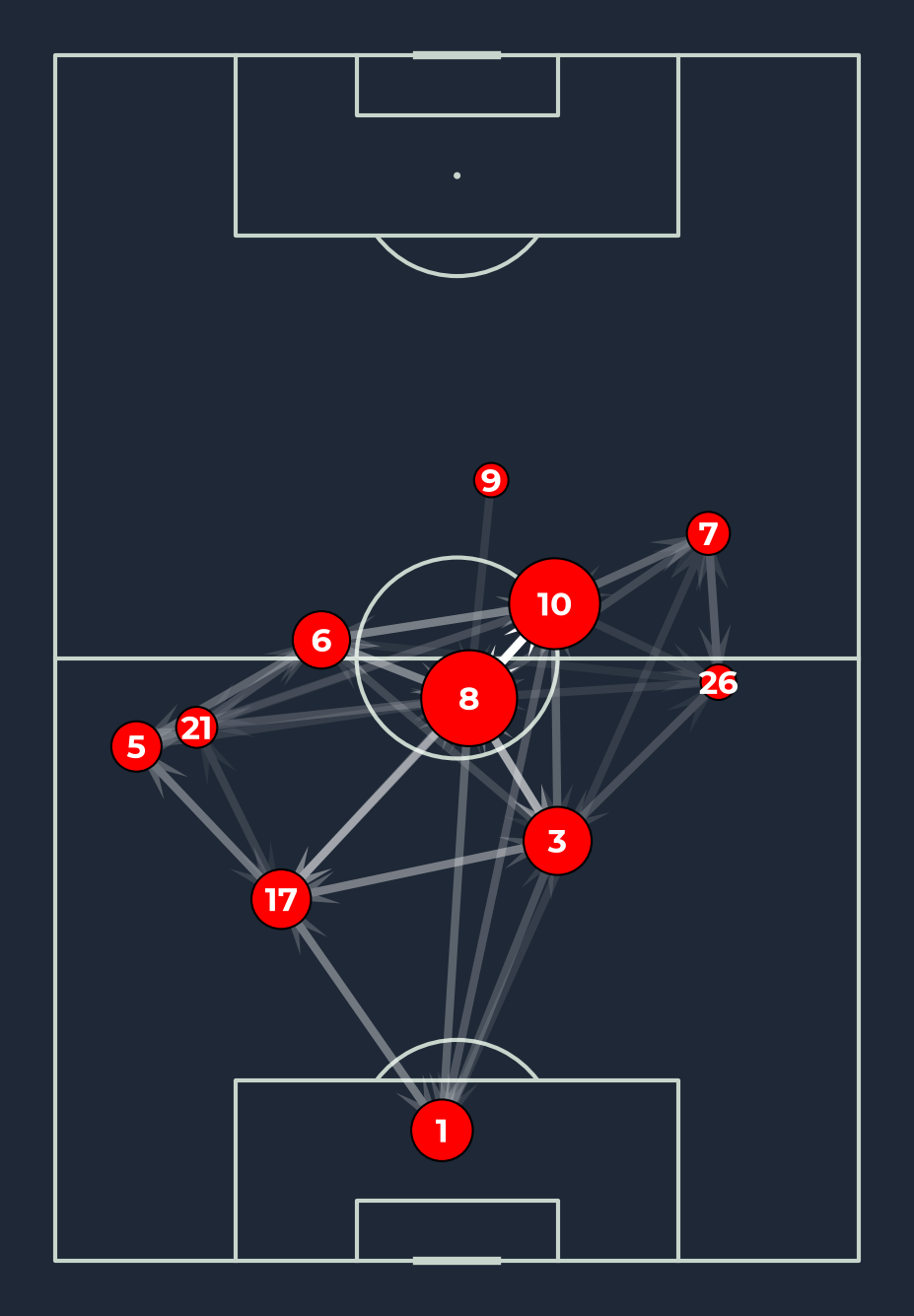
On the other side, Norway tried to trigger their attack under pressure. Repeating the pattern seen against Brazil and Ivory Coast, Martin Ødegaard was forced to drop from his attacking midfield position to act almost as a defensive midfielder, helping Norway’s center-backs in the build-up. Figure 2 proves the number 10 acting in a position close to that of a deep-lying playmaker. This deep drop improved the ball progression in the first third, but inevitably kept him away from the assist zones.
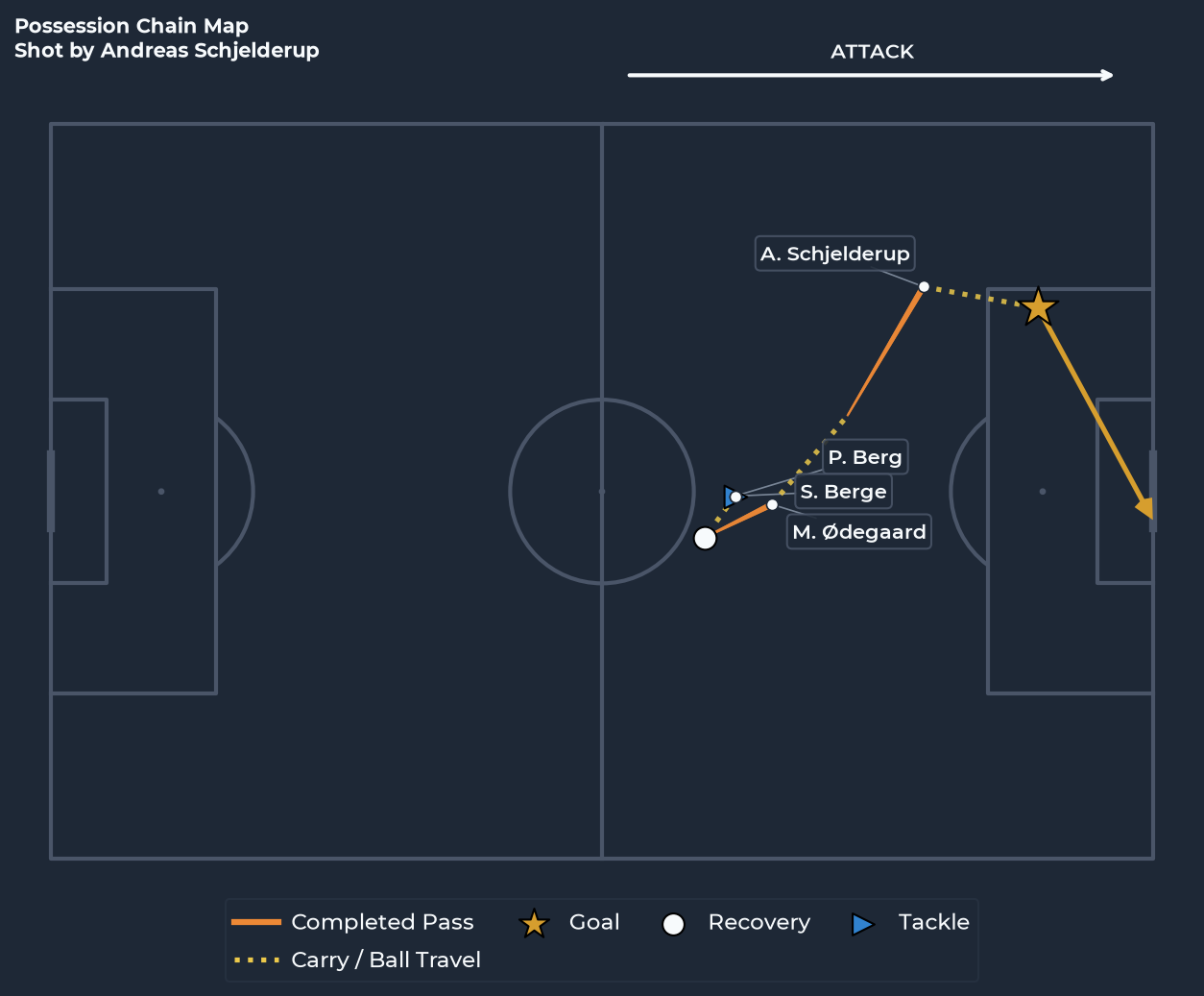
Despite having less of the ball, Norway was lethal. The first goal was an absolute beauty, with a shot from Schjelderup that surprised goalkeeper Pickford. Figure 3 details the rapid vertical transition — initiated by Ødegaard carrying the ball from the midfield — and demonstrates the Norwegian ability to, in their best moments, punish the opposing defense with few touches and plenty of space.
If in attack England faced inefficiency, in defense the plan was flawless: the feat of completely neutralizing Erling Haaland. The center-forward was so tightly marked that he was subbed off in extra time without significantly impacting the match (especially compared to his performance against Brazil). Norway’s passing network is already a visual example of this, showing the number 9 isolated. Thanks to the concentration of the English defensive sector, the top scorer was unable to establish his game, being unable to operate in tight spaces or with space to run at speed.
The English response to the setback was immediate and demonstrated the team’s mental strength. Just minutes after seeing Norway open the scoring, England finally managed to break the monotony of their sterile ball possession and find the necessary gap to infiltrate the compact Nordic defense. Breaking through the opposing block with precision, the national team translated their high volume of play into a lethal infiltration to seek the equalizer in the final stretch of the first half.
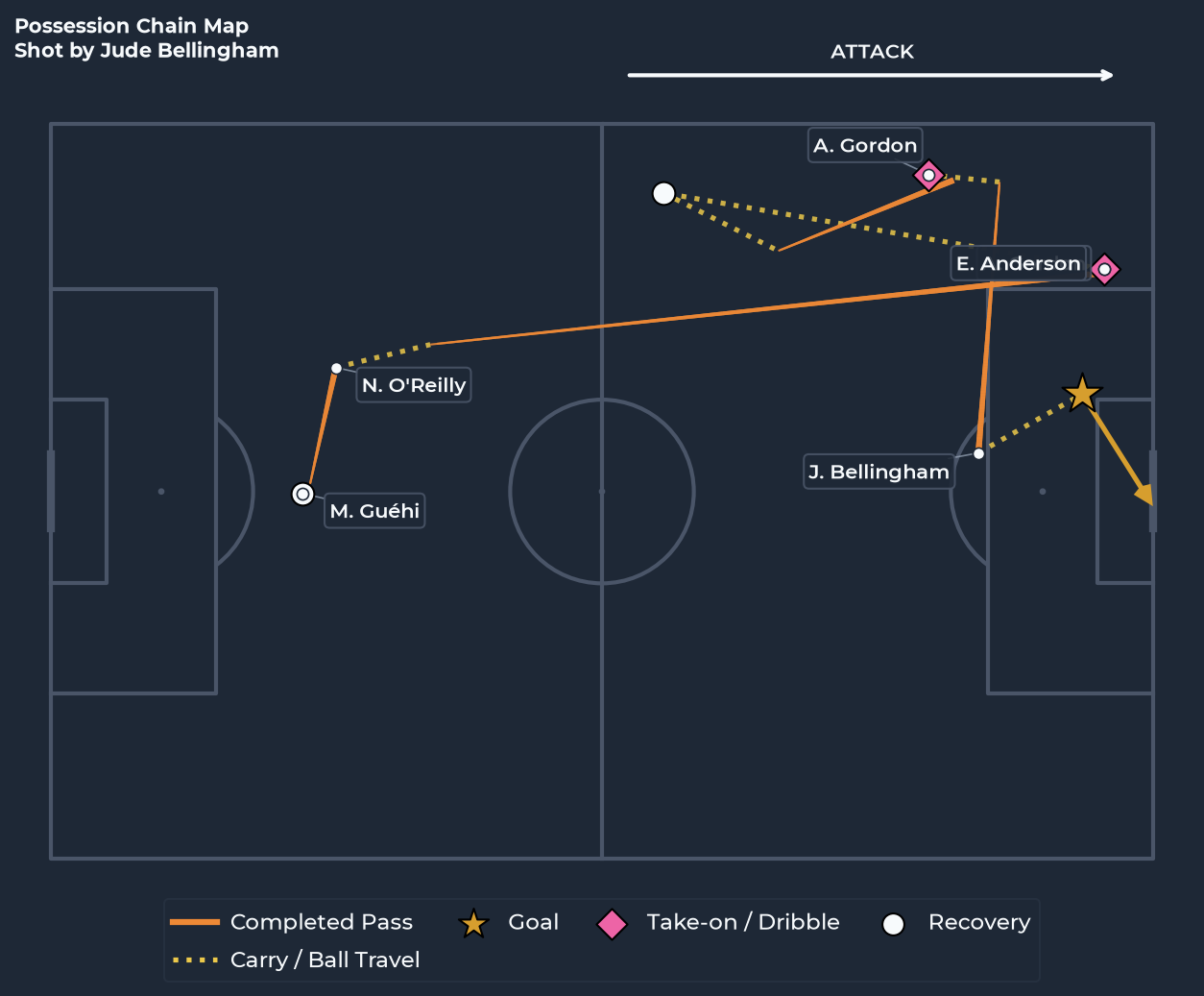
Figure 4 maps precisely the build-up of this play that culminated in Bellingham’s goal. The collective sequence resulted in an effective infiltration, solving at that moment the problem of lethality and the excess of “U-shaped” lateral passes that had been stalling the team.
The Second Half and the Tension in Extra Time
The return from halftime presented strong alternations of dominance. Far from retreating after conceding the equalizer, Norway found the breath to cause trouble in several windows with peaks of pressure and volume, preventing England from establishing a continuous siege.
In extra time, tactical and physical rigor was tested to the limit. The extra period turned into a seesaw: the English were more incisive and accumulated momentum in the first half, scoring the winning goal right at the beginning of the first half of extra time, once again with Bellingham. At a disadvantage, Norway responded with sharp attacks in the final 15 minutes. It was in this scenario of sheer exhaustion that English collective resilience spoke louder to secure the result.
Conclusion
The match illustrated the classic clash between English possession control and Norway’s adaptive verticality. England advances with the enormous defensive merit of having neutralized the tournament’s most lethal attacker, but will need to translate their ball volume into more direct chances if they want the world title. Norway, in turn, bids farewell showing excellent organization, resilience, and interesting tactical adaptations, such as their number 10 dropping deep to help the center-backs in the build-up.
Analysis: Argentina 3-1 Switzerland
Introduction
In a balanced clash, Argentina secured the final spot in the World Cup semi-finals by defeating Switzerland 3-1 after extra time. Once again, the Argentine national team showed resilience and knew how to capitalize on the match’s context to eliminate an opponent that had a great tournament, balanced in all phases of play and very physically strong.
For the second consecutive game, “La Scaloneta” started the match in a 4-1-3-2 with Paredes acting as the playmaker in place of Thiago Almada. While this change suggests a more defensive stance, what we have seen is that the inclusion of the defensive midfielder leaves the team more balanced and frees up the Argentine full-backs and midfielders to participate more in the build-up, actually making the team more offensive.
Match Report and Tactical Analysis
First Half: Quick goal and tactical adaptation
The game began with both teams feeling each other out and seeking control of the match, but right at the 10-minute mark, Argentina opened the scoring with a Mac Allister header from a Lionel Messi corner kick.
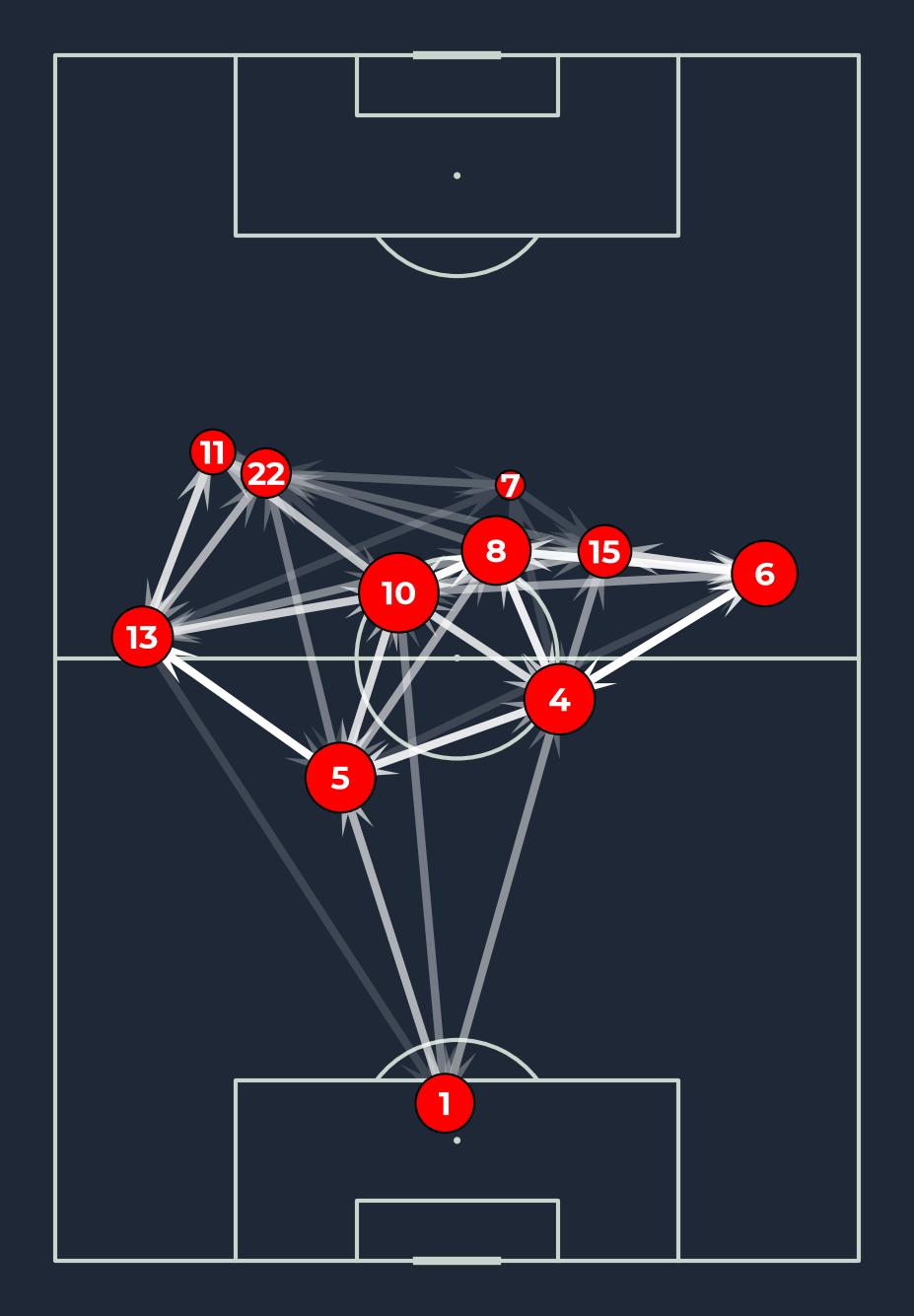
After Argentina’s goal, Switzerland tried to take more control of the game’s actions through ball possession, looking to build play with triangulations on the flanks—especially on the right side—and circulating through the middle with Xhaka. The number 10 attempted varying passes and inside combinations, as the team’s passing network clearly shows.
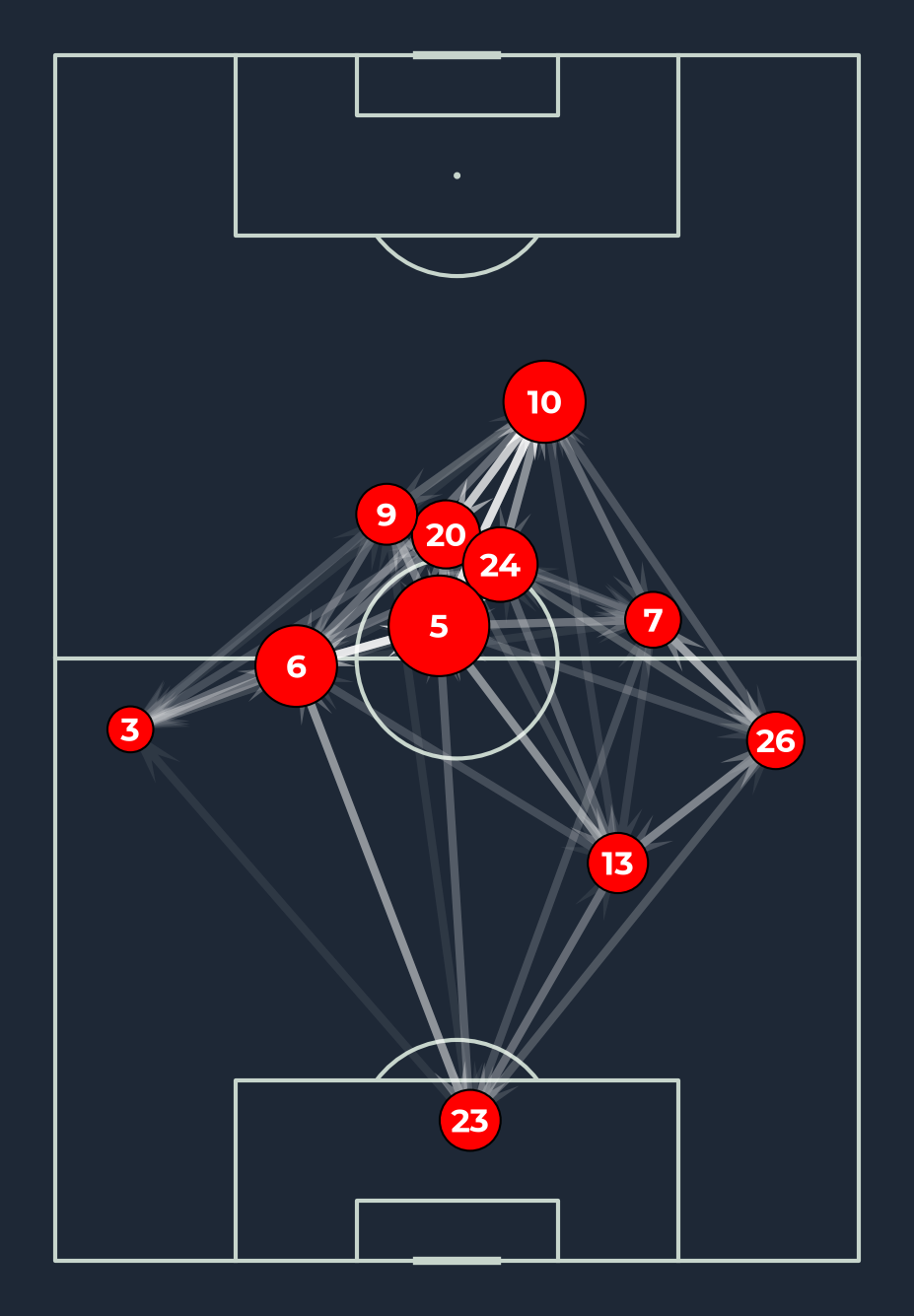
Argentina, on the other hand, dropped back and started playing in transition, always looking to recover the ball in their defensive half and find Messi, who stayed pushed up. The idea was simple: the number 10 would receive the ball, shield it, and drive forward while his teammates arrived at speed to receive the pass and finish the plays. Argentina’s passing network also highlights the team’s strategic behavior.
Neither team found much success with their strategies, and the first half ended quietly, without many opportunities for either side after Argentina’s opening goal.
Second Half: Swiss blitz and Embolo's red card
The teams returned for the second half with the same game plans as before, but with more directness and faster attacks, which left the game more open with chances for both sides. Argentina struck first on two counter-attacks, with shots from Molina and Álvarez.
However, the Swiss national team persisted, taking control of the match and launching their offensive. First, Embolo received a through ball and left Ndoye one-on-one with the goalkeeper, but his hesitation to shoot gave Licha Martínez the chance to cover the space and block the shot. After that, Switzerland had another opportunity from a ball recovery while pressing Argentina’s build-up, featuring a quick exchange of passes and a switch of play, but it didn’t end in a finish.
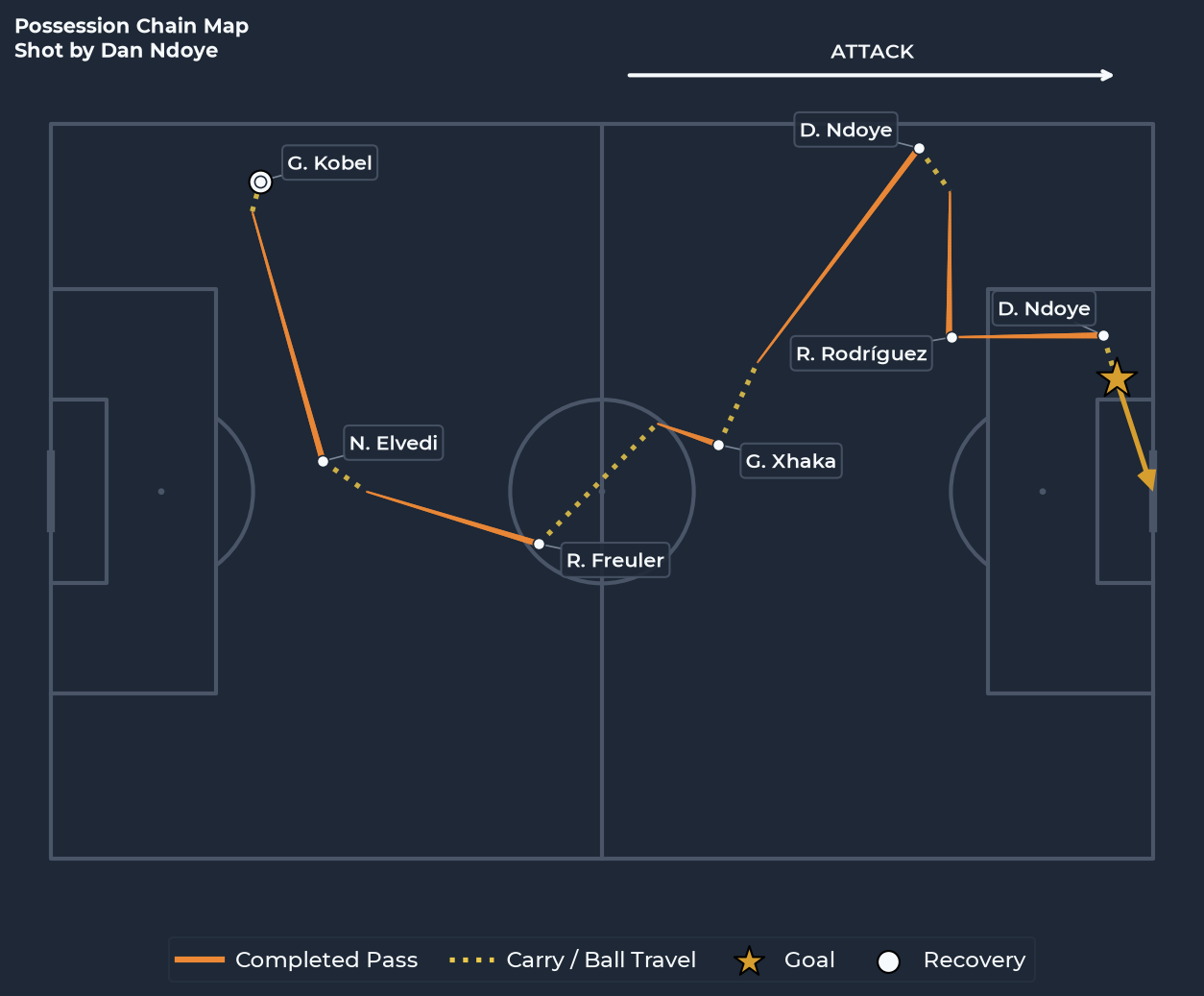
Switzerland remained patient, passing the ball to find spaces, and that’s how the goal came: in yet another passing sequence, this time on the left flank, Ndoye played a one-two with Rodríguez and finished without hesitation to tie the match.
Switzerland was in control of the match, but lost it following a dive by Embolo, who, after VAR intervention, received his second yellow card and was sent off.
Scaloni used the hydration break to organize his team around their numerical advantage, while Switzerland shifted their system to a 5-3-1. The formation proved efficient in numerical disadvantage situations, having been adopted by teams like England, who used it against Mexico in the Round of 16, for example.
Argentina tried to press, but with tired players, they struggled to create opportunities, resorting to Messi’s sheer brilliance, who nearly scored with a right-footed shot. In another sequence, Kobel made an incredible save on a header by Martínez — neutralizing the final threat before the end of regulation time.
Extra Time: The relentless search for a goal
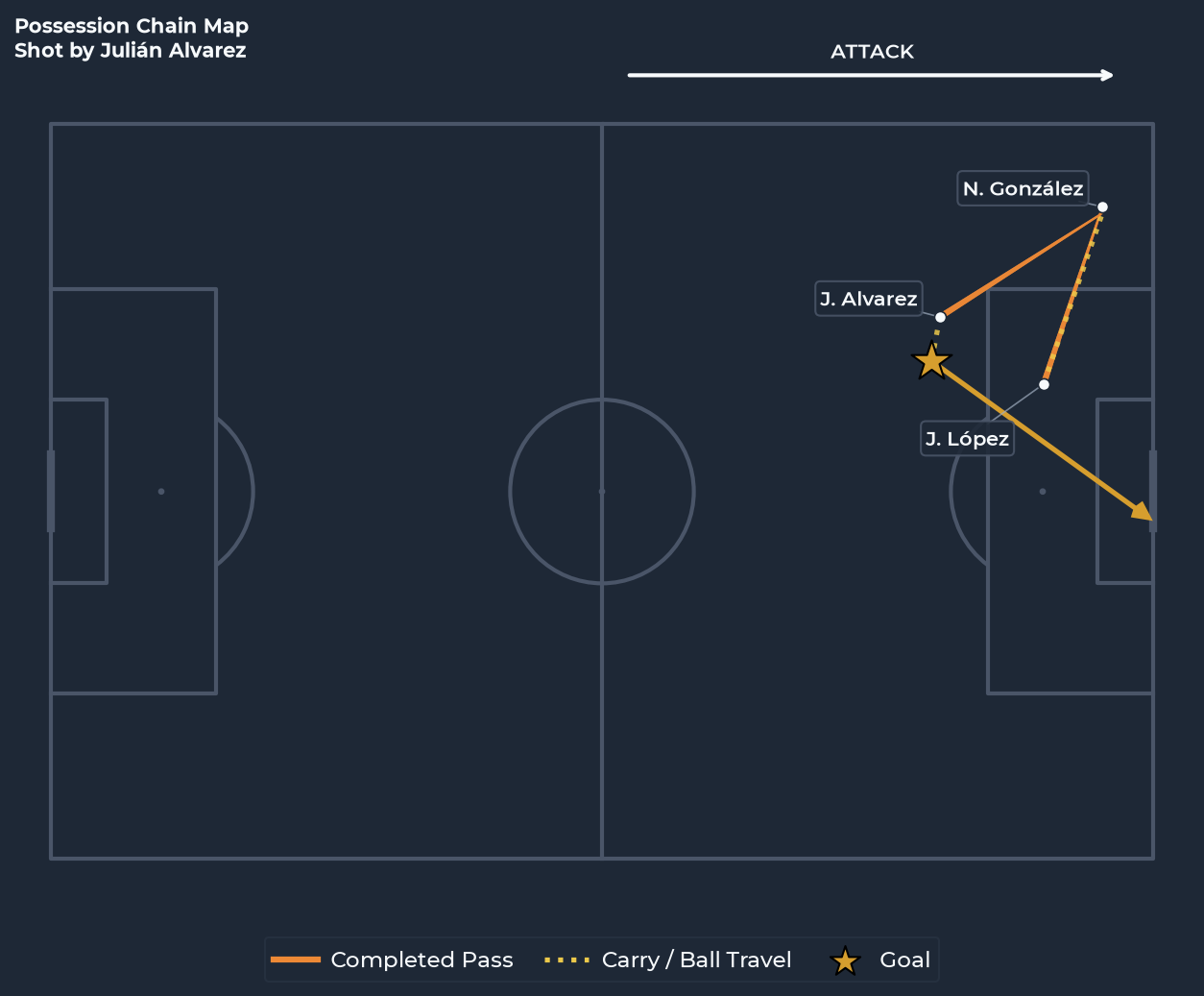
Looking to exploit their numerical advantage and kill off the match in extra time, Argentina made changes that left the team entirely offensive-minded. Even so, the team still struggled to penetrate the Swiss low block. As a result, the South Americans began attempting crosses and long-range shots until, in the second half of extra time, Álvarez managed to strike a beautiful shot into the net, leaving Kobel no chance to save it.
Switzerland fought hard to equalize, but exhausted and a man down, they failed to create any real danger. And on yet another Argentine counter-attack, Lautaro Martínez put the game to bed by scoring — securing Argentina’s qualification.
Conclusion
The reigning world champions faced difficulties in yet another clash, but once again proved capable of finding different ways to play and win. They now move on to a duel against England, an opponent the Argentine squad has met on previous occasions, sharing a deep rivalry stemming from Maradona’s famous performance in the ‘86 World Cup. The English will be out for revenge, and Argentina will need to find a way to be more intense and physical than they have been in these knockout fixtures.
Enjoy Reading This Article?
Here are some more articles you might like to read next: