Analysis: Brazil 3x0 Haiti - 2026 World Cup
Se quiser ler este texto em pt-br, clique aqui.
Introduction
This Friday (June 19th), Brazil played their second group stage match against Haiti in Philadelphia. Fulfilling the expectations as the match favorites, the duel resulted in an expressive 3-0 victory for the Brazilian National Team.
Even though they are tied on points with Morocco, this victory secured the top spot in Group C for Brazil through goal difference (+3 goal difference, compared to Morocco’s +1). It is in the team’s best interest to strive to maintain this lead, and, in theory, ensure an easier path in the knockout stage of the competition.
Regarding the starting lineups, Brazil opted for a 4-3-3 formation, featuring an attacking trio with Matheus Cunha playing centrally, flanked by Vinícius Jr. and Raphinha on the left and right wings, respectively. The defensive system also saw the introduction of Danilo in place of Ibañez. The Caribbean squad, on the other hand, bet on a 5-4-1 variation with center-forward Frantzdy Pierrot leading the line.
Match Summary
First Half: Tactical Fit, Goals, and Raphinha's Injury
Unlike the anxiety displayed against Morocco, the Brazilian squad performed more fluidly, taking advantage of the fact that Haiti attempted to play out from the back rather than adopting a strictly defensive posture. By relinquishing a low defensive block, the Caribbean team tried to compensate with tighter marking, earning them a yellow card just 3 minutes in. With more spaces available on the pitch, Brazil did not take long to test the opponents’ organization: at the 11-minute mark, the team began exploiting Haiti’s high line with through balls, leading to a goal by Raphinha that was ultimately ruled out for offside.
Tactically, Ancelotti’s major change was the constant dropping back of Matheus Cunha to link up with the midfield, forming a 4-4-2 diamond in the central channels and causing hesitation in the opposing defense.
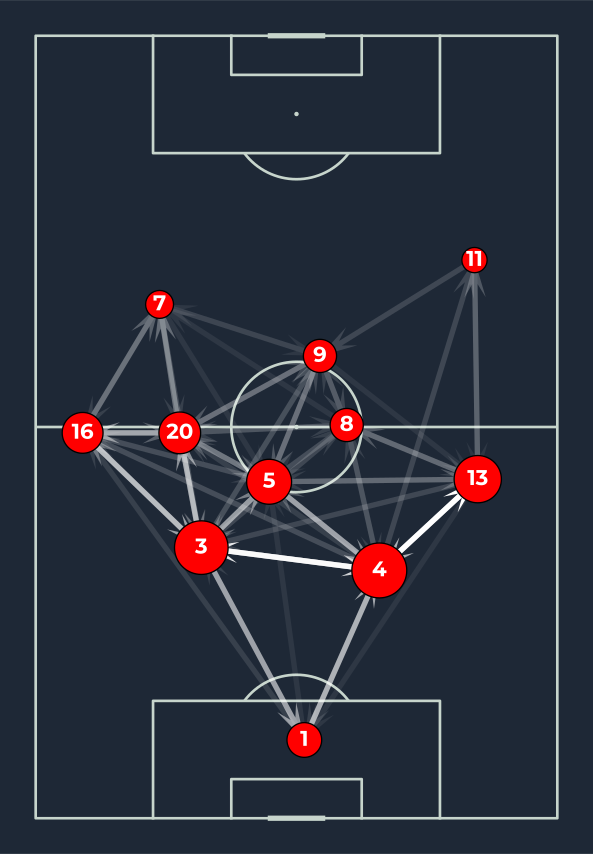
The fluidity of this variation is evident in Brazil’s passing network. The center-forward’s node (No. 9) was highly connected to the midfielders, avoiding the offensive isolation seen in the previous match.
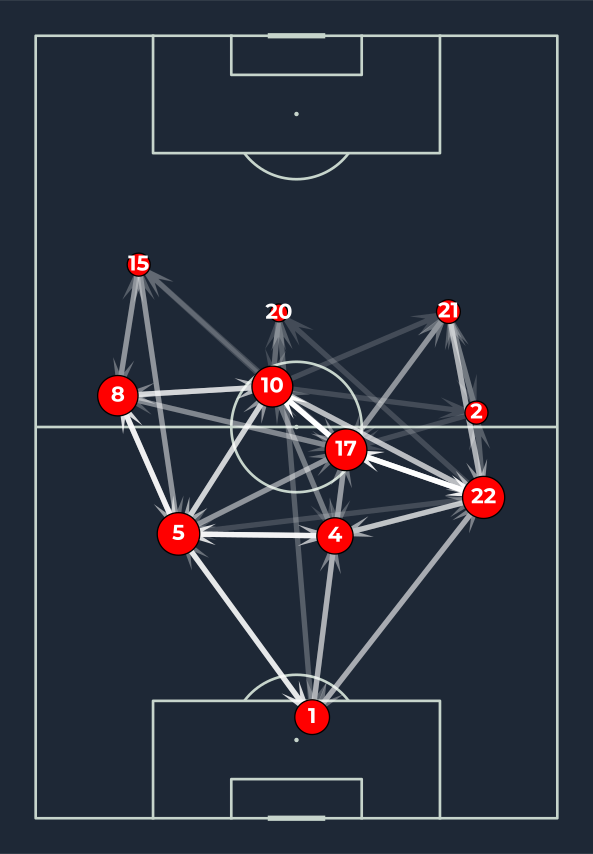
Conversely, Haiti’s network reveals a stifled team with harmless connections, reflecting their difficulty in breaking through the Brazilian block. Attempting to build up play through the middle, the Haitians were severely punished.
At 22 minutes, the Brazilian press on the opponent’s build-up yielded results: Matheus Cunha dispossessed the defense and, following a shot by Vinícius Júnior, capitalized on the rebound to open the scoring. Broadly dominating the game—reaching 56% ball possession at 33 minutes—Brazil soon extended their lead. At 35 minutes, capitalizing on another forced error in the Haitian transition, Paquetá recovered possession, and Vinícius Júnior played a diagonal pass to Matheus Cunha to score the second goal.
Shortly after the second goal, Raphinha, who was already not performing at his best in the match, felt discomfort in the exact location of an old injury and had to be substituted. The injury is particularly concerning given Ancelotti’s preferred tactical setup, as he considers Raphinha a fundamental piece for exploiting depth, granting him the freedom to drift inside and attack the space behind the center-backs.
Despite the substitution, the team maintained its intensity, and at 47 minutes, once again exposed the Caribbean side’s lack of compactness. Paquetá turned with space in the attacking midfield and sent a through ball to Vinícius Júnior, who scored the third goal, closing the scoreline before halftime.
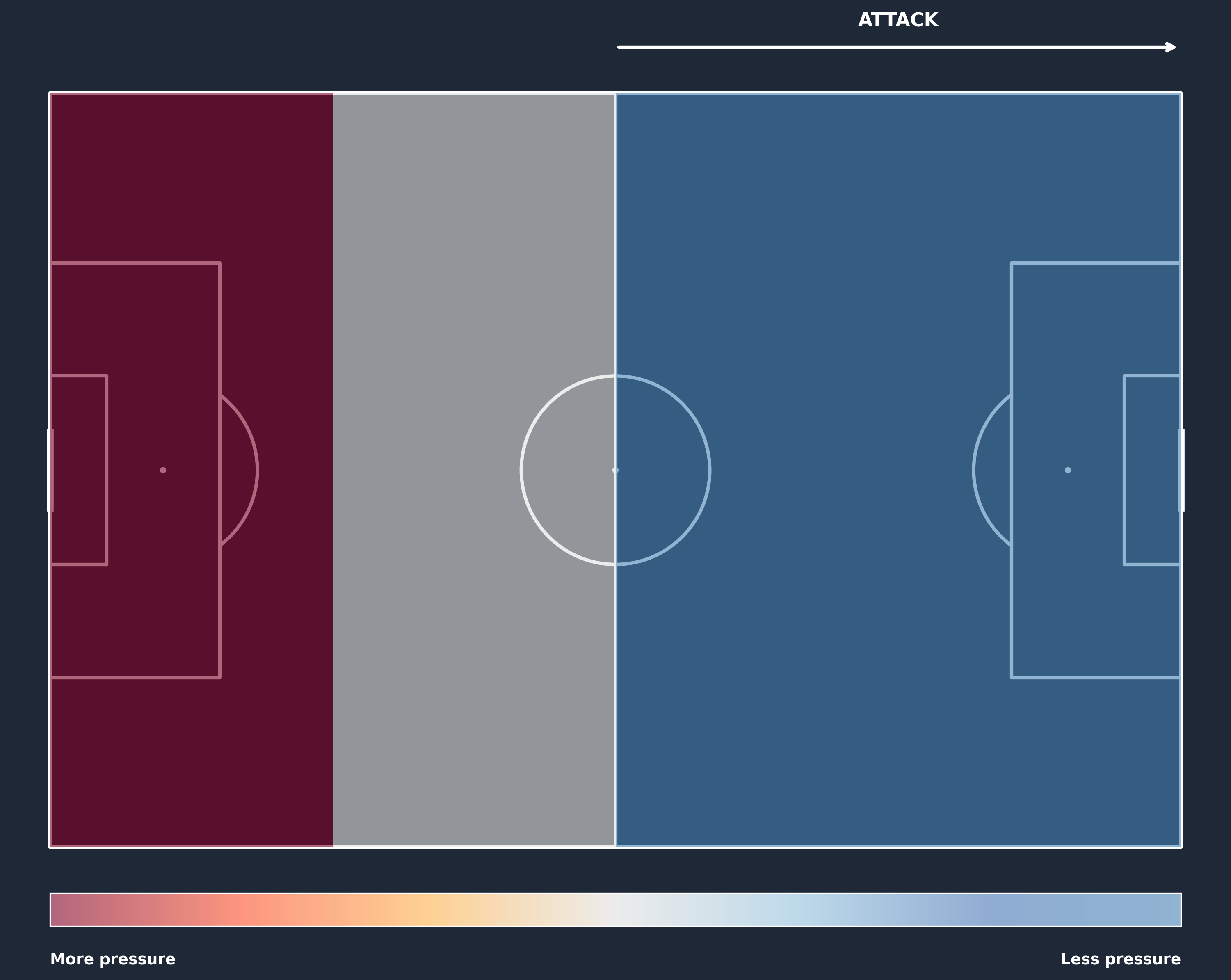
Haiti’s PPDA map corroborates the team’s tactical passivity. Even while trying to dictate the play, the Caribbean squad only managed to exert effective defensive pressure inside their own penalty box (warm tones), offering tremendous freedom to Brazil’s creative sector.
Second Half: Lead Management and Physical Conservation
With the victory all but secured, the first 15 minutes of the second half were characterized by positional management from Brazil, aiming to preserve the players’ physical condition. The tempo dropped drastically: the National Team went almost 30 minutes without a shot and, as illustrated by the following pressure map, concentrated their actions in deeper zones of the pitch, forcing the opponent to chase the ball.
.png "PPDA Map - Brazil")
Brazil’s PPDA map reflects this effort management. Without the need for an intense counter-press in the attacking third, the team distributed its marking across the central channels. When Haiti tried to force the play, they ran into solid defensive statistics: 11 tackles, 10 interceptions, and 15 clearances by the Brazilian team.
Taking advantage of the mild pace, Ancelotti rotated the squad at 18 minutes, bringing on Endrick and Martinelli. Brazil’s few offensive actions were reduced to sporadic plays, such as an Endrick goal disallowed for offside at 32 minutes. Defensively, Haiti’s rare aerial threats were safely neutralized by goalkeeper Alisson, maintaining total control until the final whistle.
Conclusion
Contrasting with the difficulties of their debut, the 3-0 victory over Haiti was a demonstration of efficiency. The match highlighted that against opponents who surrender space and try to play openly, Brazil punishes transition errors with great ease. The shift to a 4-4-2 diamond connected the midfield and optimized spaces for the attackers.
Even though the opponent may not serve as a definitive technical benchmark, the result was vital for the team’s confidence, especially for Vinícius Júnior, who showed great assurance in his decision-making. The main point of concern lies with the medical department, which will need to reassess Raphinha’s injury just days before the start of the knockout stage.
In their next match, against Scotland, Brazil seeks to secure the top spot in Group C. The expectation is to face a much more closed and reactive side, which will once again require patience to break down defensive lines, but with the advantage of playing with their qualification already on track and in a less pressured environment.
Enjoy Reading This Article?
Here are some more articles you might like to read next: