Analysis: Brazil 1x1 Morocco - 2026 World Cup
Se quiser ler este texto em pt-br, clique aqui.
Introduction
Debuting in the group stage of the 2026 World Cup, Brazil faced the Moroccan national team at MetLife Stadium in New Jersey. In the end, Brazil drew 1-1 against Morocco, creating fierce competition for the top spot among the group’s strongest teams.
The five-time world champions remain under pressure and need to correct simple mistakes that have proven costly. On the other hand, Morocco enters the pitch at a historic peak, having established themselves as semifinalists in the last World Cup and champions of the Africa Cup of Nations.
The starting lineups created a widespread clash in a 4-2-3-1 formation. Brazil bet on Igor Thiago’s box presence as a traditional number 9, while the Moroccan strategy focused on retaining the ball with Brahim Díaz to dictate the pace of the game.
Match Summary
First Half: Initial Struggles, Scares, and Reaction
Unlike the intensity shown at the beginning of the match against Egypt, the Brazilian National Team started the game slowly, displaying nervousness. Struggling to maintain ball possession, the team constantly made mistakes in ball control and passing. They frequently resorted to long balls during the build-up, suffering heavy pressure from the Moroccan team.
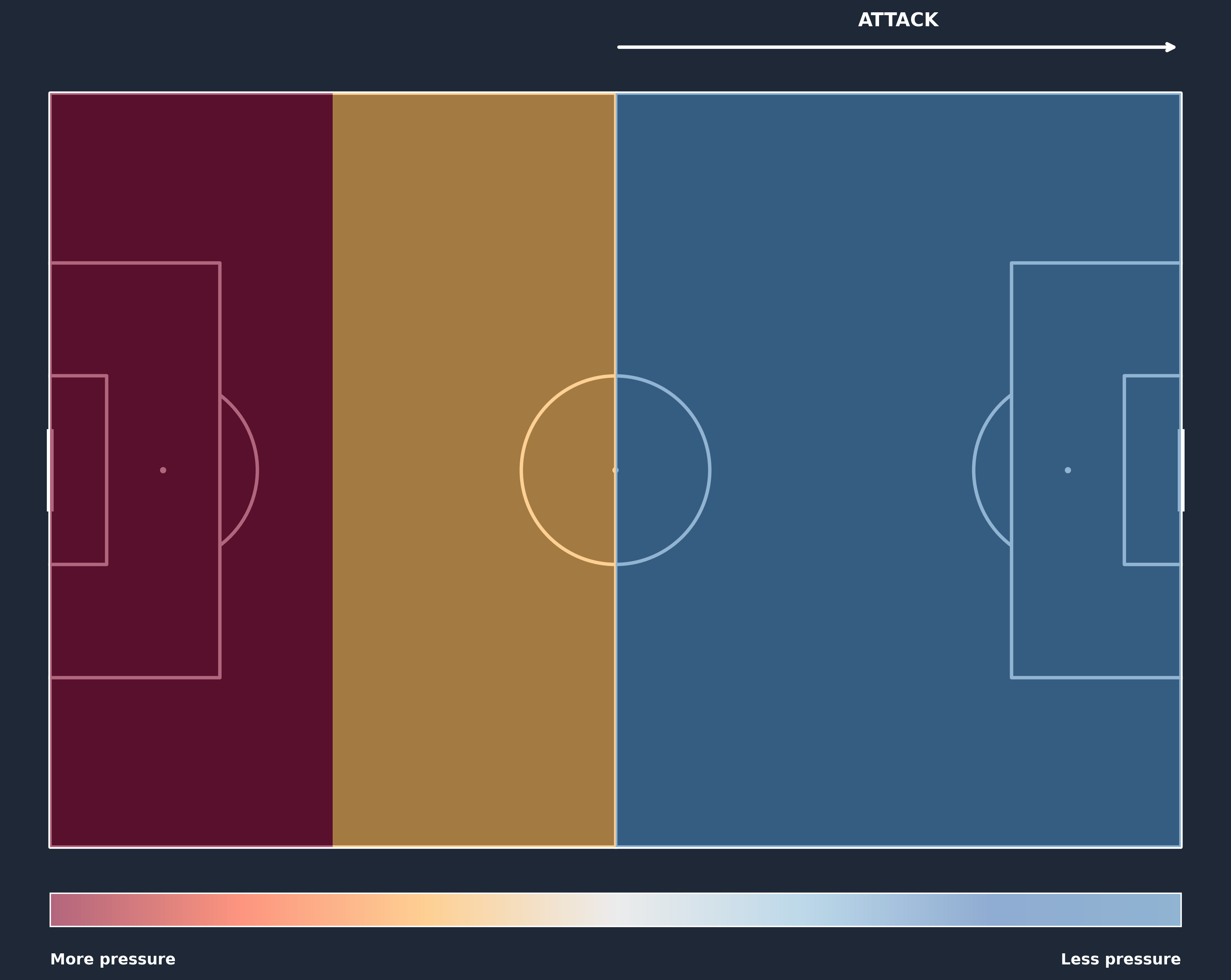
Morocco’s strategy becomes clear when looking at their PPDA (Passes Per Defensive Action) map. The metric illustrates that, in the offensive third (Brazil’s defensive third), Morocco did not apply aggressive marking, saving themselves from the physical toll of intense pressing. The team opted for quick transitions and counter-attacks, which was evident in the Moroccan goal.
Tactically, the Brazilian squad started again in a 4-2-3-1, but varied to a 4-3-3 and a 4-2-4 in possession, with the three midfielders constantly switching positions. The mechanics, however, did not work very well. Casemiro did not perform as expected when pushing forward as an attacking midfielder, and Paquetá, despite providing good dynamics, committed simple errors.
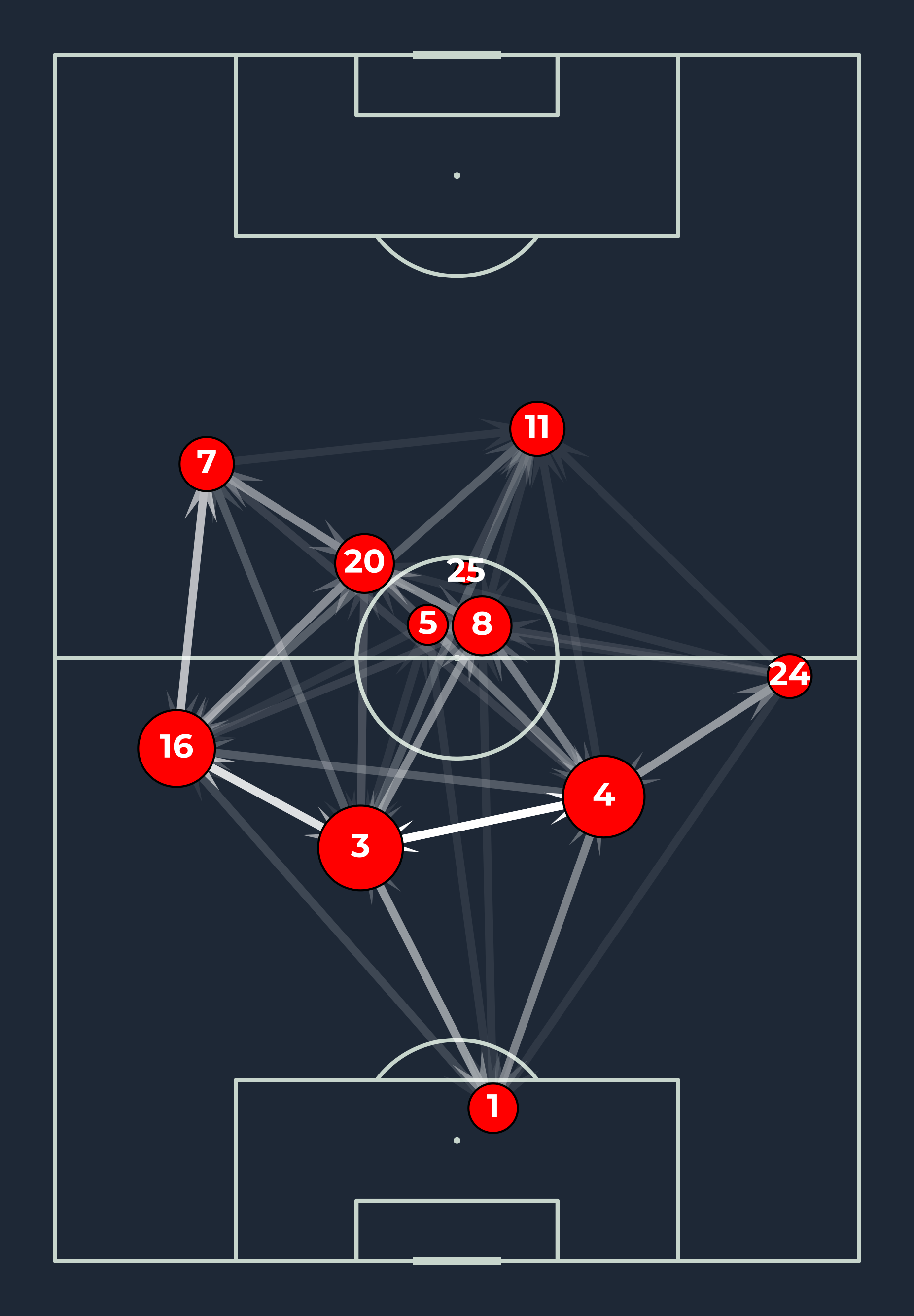
Furthermore, focusing on the midfield, the sector’s ineffectiveness is evident when observing the team’s passing network. The chart illustrates a disconnected area with little influence on ball progression. As a reflection of the lack of passing options inside, center-back Gabriel Magalhães ended up being the team’s primary “playmaker,” concentrating the highest volume of passes (85 passes, 82 of them accurate). As a consequence of this difficulty in connecting defense to attack, center-forward Igor Thiago was left completely isolated, recording rare interactions with the rest of the team (6 passes, 5 of them accurate).
Still in the midfield, Morocco capitalized on a poor touch by Lucas Paquetá. Winger Brahim Díaz moved centrally to receive the ball, confusing the poorly positioned Brazilian defense, which did not anticipate the movement. Brahim seized the passing opportunity, finding Saibari between the Brazilian center-backs. The Moroccan number 11 chipped the ball over goalkeeper Alisson to open the scoring. The conceded goal left the Brazilian team somewhat disoriented, allowing Morocco to take control and dominate the game’s actions.
Brazil’s reaction was not the result of tactical dominance or offensive superiority, but rather individual brilliance. Lucas Paquetá drifted to the left side and found Vinícius Júnior with open space. Vini carried the ball and played it inside to Bruno Guimarães who, despite being tightly marked, managed a great pass between the defenders to return the ball to the number 7. Vinícius Jr. invaded the penalty area, cut past a Moroccan defender, and finished masterfully to tie the game.
Second Half: Substitutions, Tactical Variation, and Balance
Returning from the break, head coach Carlo Ancelotti made significant changes to the team. Ibañez was being beaten too easily in one-on-one situations, and Casemiro was not having a good game. Having the courage to pull a veteran and alter the defensive line, he brought on Fabinho and Danilo to replace them. Fabinho came on very well, providing much more mobility and protection to the Brazilian midfield, while Danilo maintained security in the defensive line. With these changes, Brazil managed to retain better control of the game.
Overall Match Statistics Comparison:
At the 61st minute, seeking the lead, the coaching staff made further changes, taking off Paquetá and Igor Thiago for Matheus Cunha and Luiz Henrique. The substitutions shifted Brazil’s structure to a 4-2-4 in possession, and a variation between a 4-4-2 and a 4-5-1 during the defensive phase. The new formation almost bore fruit at the 66-minute mark when Luiz Henrique made a good run down the byline and passed to Bruno Guimarães, who crossed into the box, but Raphinha could not reach the ball in time to finish.
Despite the more offensive posture, the heavily populated attacking structure did not work perfectly. With an emptied midfield, Morocco managed to regain some control of the game’s actions around the 70th minute.
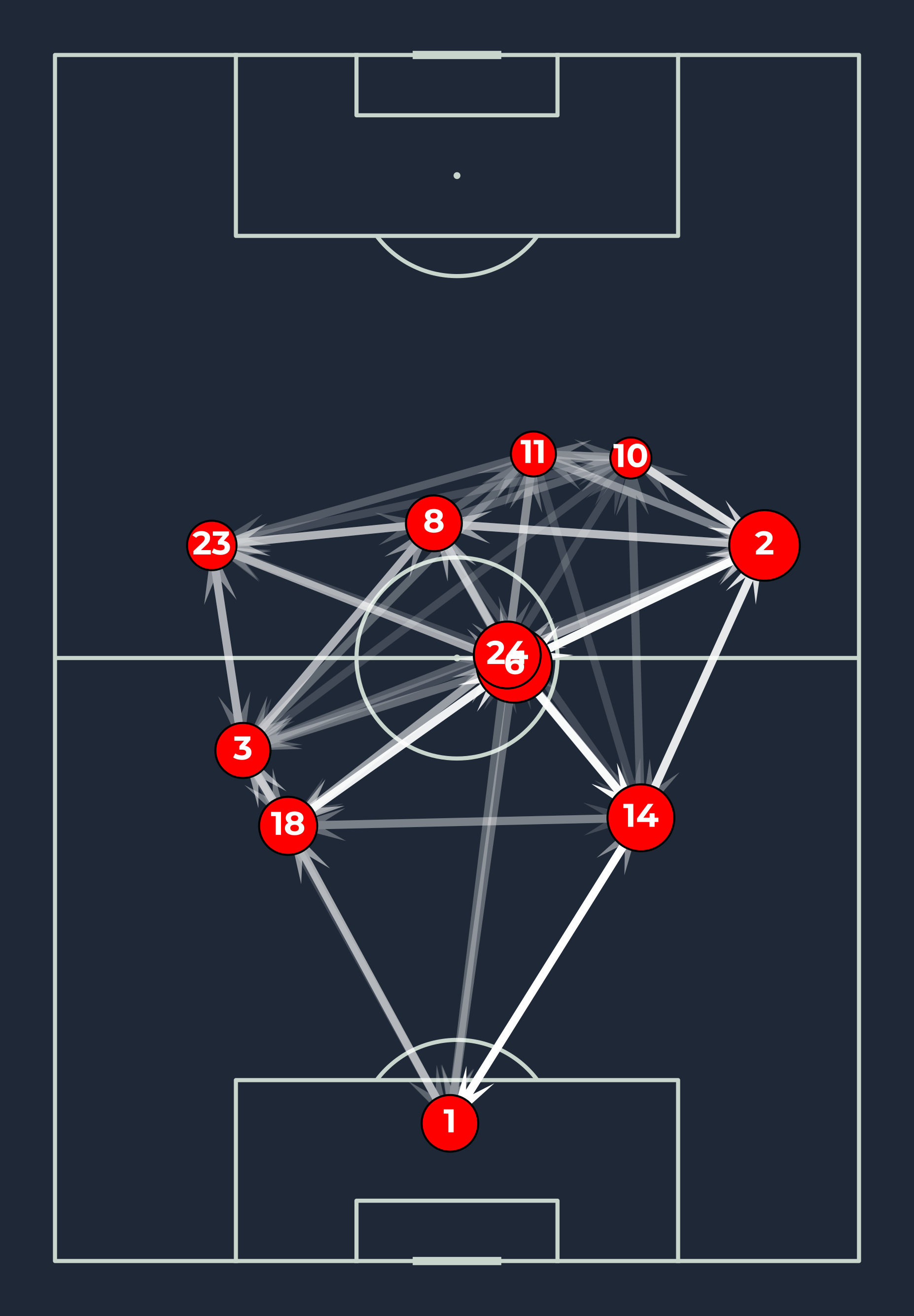
The reason for this Moroccan territorial dominance is evident in their passing network, which heavily contrasts with Brazil’s build-up struggles. The chart shows a solid and connected structure. The offensive standout was full-back Hakimi (number 2), who acted as the primary engine for right-side buildup. Additionally, the positional overlap of numbers 24 and 6 illustrates the formation of a dense and compact midfield, which took advantage of Brazil’s depleted sector to dictate the rhythm.
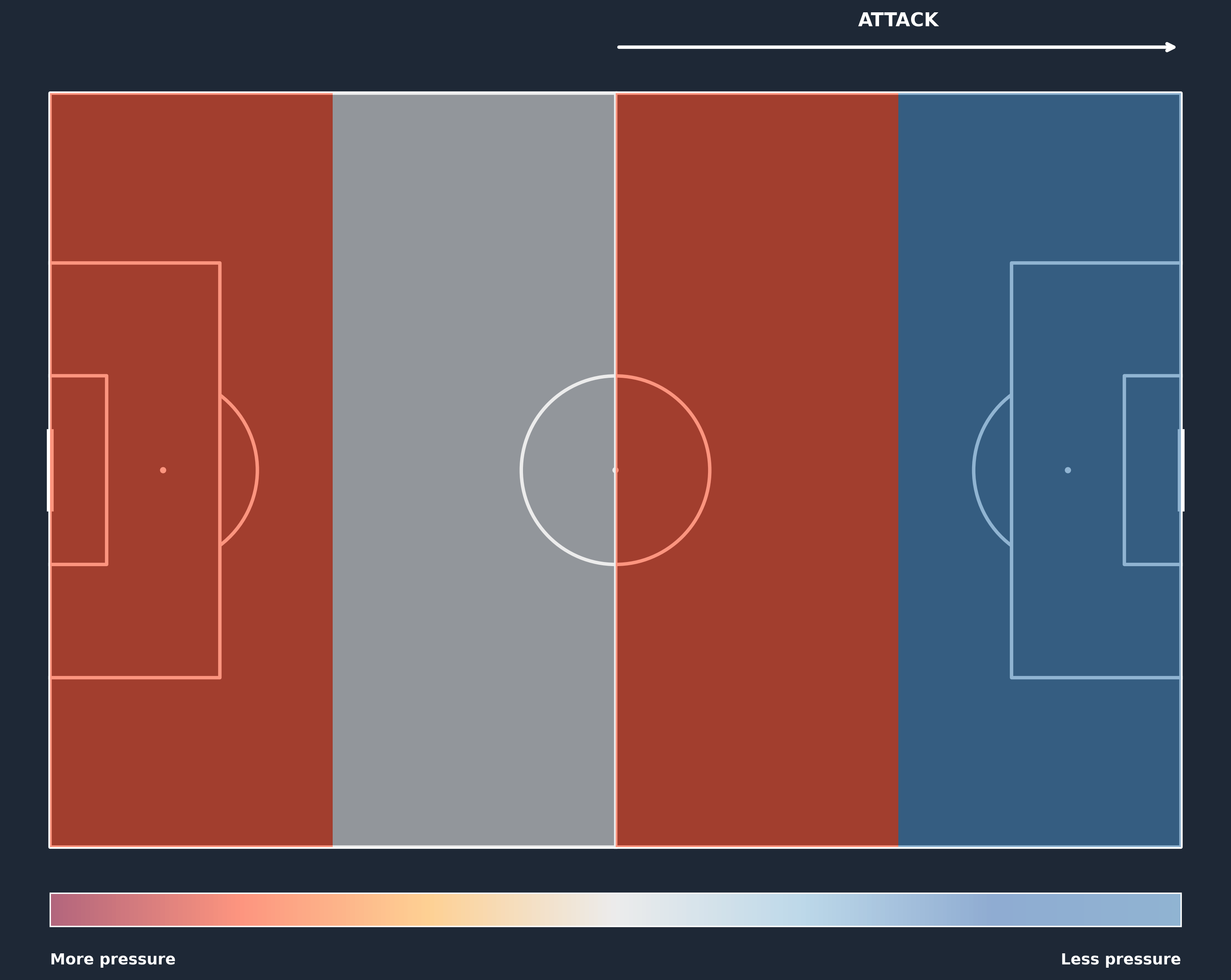
Brazil’s PPDA map illustrates the team’s true defensive scenario. Although the Seleção tried to push their lines higher and press the opponent’s build-up at a certain point in the game, the metric shows that effective defensive pressure ended up being concentrated almost exclusively in their own defensive third (in warm colors). This corroborates the fact that Morocco was able to easily break Brazil’s first line of pressing. Consequently, Brazil was forced to drop back.
Brazil began relying on fast transitions and, at the 77-minute mark, executed what was tactically their best-constructed play of the match. Alisson quickly distributed the ball to the midfield for Matheus Cunha. The forward drew the markers, creating perfect hesitation among the defenders about who should track him, and, with excellent vision, found a beautiful pass out wide to Vinícius Júnior. Vini played a one-touch pass to Raphinha, who was arriving unmarked in the box following a well-designed collective movement. The forward, however, struck the ball poorly, making for an easy save by the goalkeeper.
At 80 minutes, heavy physical exhaustion forced Bruno Guimarães off for Danilo Santos, using up Brazil’s five-substitution limit. The game remained tense until the final moments. Deep into stoppage time, at 92 minutes, Brazil had their last big chance: following a corner kick, the ball fell to Raphinha, who played it right to Luiz Henrique. He threaded the ball to Danilo Santos, who struck it hard, but straight into the goalkeeper’s hands.
The final scare came at 98 minutes. Full-back Hakimi tried to advance down the right and was dispossessed, but the ball deflected and fell cleanly to a Moroccan midfielder for a dangerous shot. Alisson parried it, gave up a rebound, but showed great reflexes to recover and secure the save in two motions, conceding only a corner and marking the end of the clash.
Sentiment Analysis: Crowd Reaction
The chart tracking the volume of positive versus negative messages perfectly reflects the tension and emotional roller coaster the match provided.
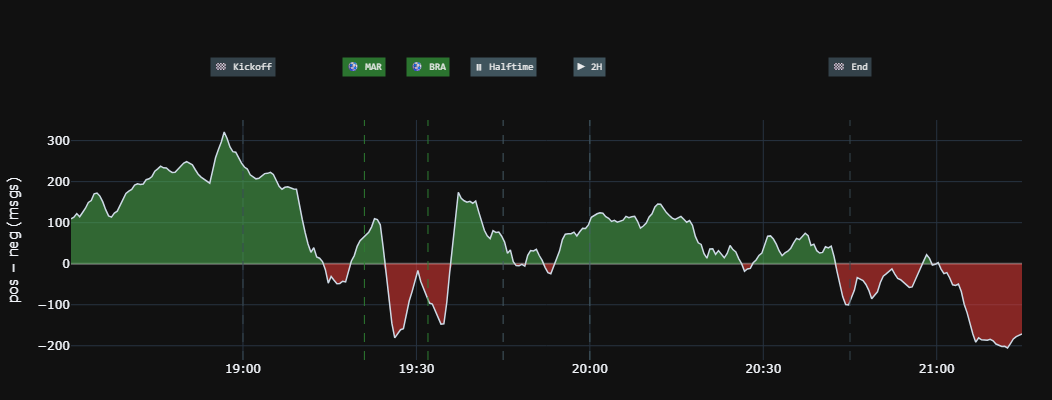
- Pre-game and Kickoff: Even before the opening whistle, there was immense excitement and optimism, with the net message sentiment reaching a positivity peak above 300. This optimism began to fade after the match started, as Brazil's struggles became apparent.
- First Half Setbacks: The moment of greatest frustration in the first half coincided directly with the Moroccan team's goal. Sentiment plummeted abruptly into the negative zone, nearing the -200 mark. Although Brazil's equalizer offered a temporary lifeline, skepticism weighed heavily, and the net sentiment remained predominantly negative until halftime.
- Recovery and Final Drop: The beginning of the second half and the tactical changes temporarily restored fans' confidence, translating into a consistent block of positive sentiment. However, as time went on (after 8:30 PM) without a comeback materializing, frustration returned. At the sound of the final whistle, especially after the 98th-minute scare, sentiment plunged once again into deep red, consolidating widespread dissatisfaction with the draw.
Conclusion
Contrary to the high expectations of a Brazilian victory, the 1-1 draw served as a harsh reality check. The match clearly demonstrated that the Moroccan team was smart to forgo exhausting pressure, accurately capitalizing on the Seleção’s structural flaws during the build-up phase.
It became evident that Brazil’s major transition problems originated from the disconnection in their midfield. The central sector’s ineffectiveness in the first half forced the defense to resort to direct long balls, which isolated Igor Thiago and left the team exposed. Although Carlo Ancelotti’s second-half interventions stopped the defensive bleeding and secured greater ball possession, the attempt to heavily populate the attack ended up emptying the midfield once again. This allowed Morocco, with a much more solid and compact structure, to regain control of the tempo in the final minutes.
Beyond tactical issues, the match highlighted a strong reliance on flashes of individual brilliance to the detriment of reliable collective mechanics. The fans’ feeling of frustration at the final whistle illustrates their impatience with a team that, despite the weight of its jersey, fluctuates dangerously within games.
Next Friday (06/19), Brazil will have the chance to redeem themselves against Haiti in Philadelphia. To avoid further setbacks in the World Cup, it will be vital for the coaching staff not only to correct defensive transition errors but also to adjust the spacing between the lines, ensuring that the attacking talent is finally supported by a functional and well-coordinated midfield.
Enjoy Reading This Article?
Here are some more articles you might like to read next: